
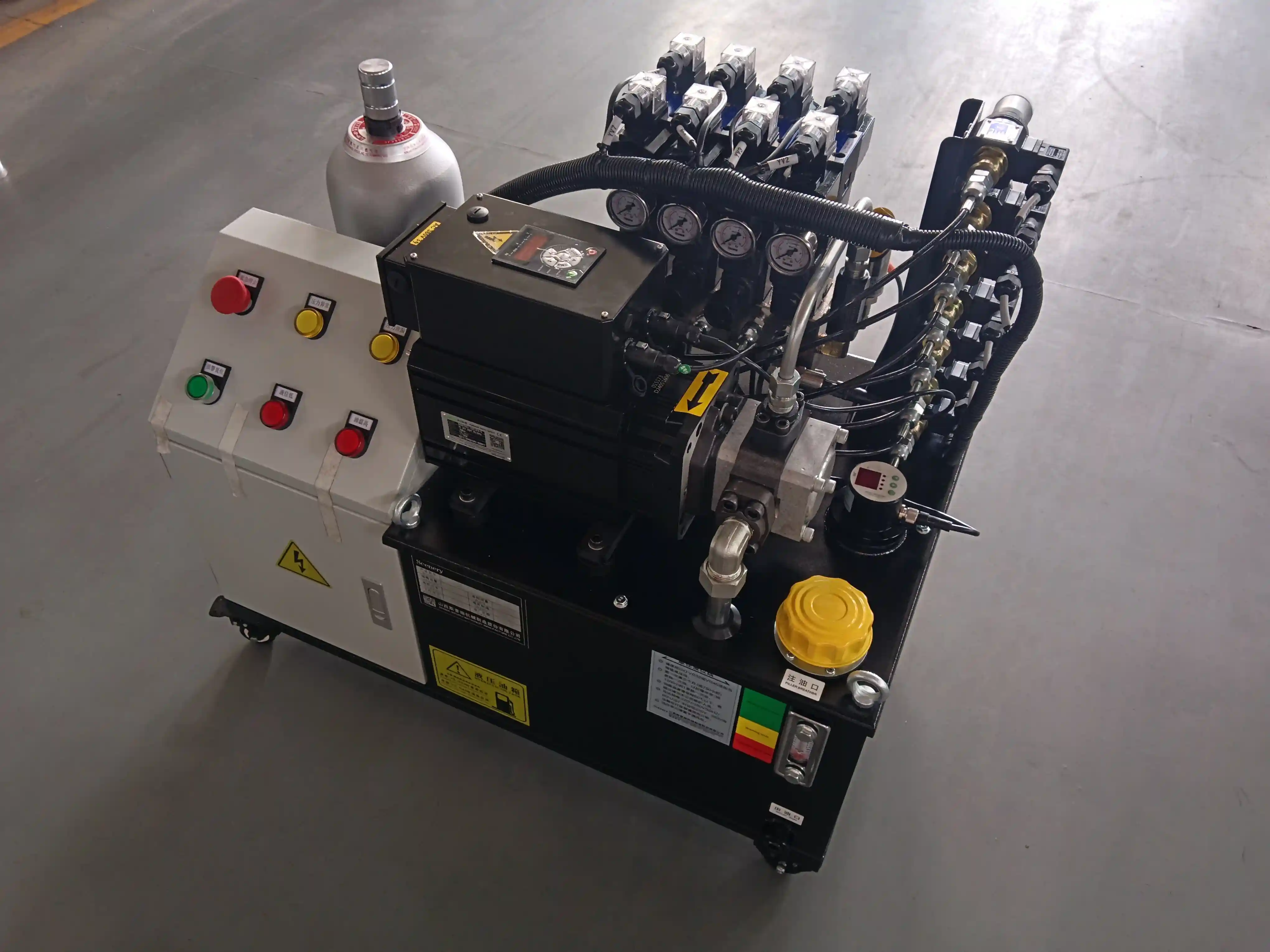
Hydraulic servo motor
The servo motor hydraulic pump station is a high-efficiency hydraulic power unit that precisely couples a servo motor and a hydraulic pump, equipped with an intelligent pressure/flow control module, hydraulic valve group, oil tank, and auxiliary components.
In modern industrial automation, hydraulic systems are expected to deliver higher precision, faster response, lower energy consumption, and smarter control capabilities. Traditional hydraulic power units—typically driven by asynchronous motors with fixed or variable displacement pumps—are increasingly unable to meet these evolving demands.
The servo motor hydraulic pump station represents a new generation of hydraulic power technology designed to solve these challenges. By combining servo motor technology with advanced hydraulic control systems, it delivers precise, efficient, and intelligent hydraulic power for a wide range of industrial applications.
What Is a Servo Motor Hydraulic Pump Station?
A servo motor hydraulic pump station is an integrated hydraulic power unit that directly couples a servo motor with a hydraulic pump. It is supported by an intelligent control system that includes pressure and flow sensors, a PLC or touchscreen interface, hydraulic valve groups, and an optimized oil tank system.
Unlike traditional hydraulic stations that rely on constant motor speed and pressure relief valves, the servo system adjusts output dynamically based on real-time demand. This allows hydraulic power to be generated only when needed, significantly improving efficiency and control accuracy.
How It Works: Closed-Loop Intelligent Control
The core principle of the servo hydraulic pump station is closed-loop feedback control.
The system receives commands from the controller and continuously adjusts the servo motor speed and torque. This directly controls the hydraulic pump output, ensuring that pressure and flow precisely match the required operating conditions.
Instead of relying on overflow valves to regulate pressure, the system intelligently distributes hydraulic oil through valve groups to the actuator. Any excess flow returns directly to the oil tank, minimizing energy waste and heat generation.
This on-demand operation model fundamentally changes how hydraulic energy is produced and consumed.
Core System Components
A servo hydraulic pump station integrates multiple advanced subsystems:
1. Servo Power Unit
The heart of the system consists of a servo motor, hydraulic pump (gear, vane, or piston type), and a dedicated servo drive. This combination enables precise speed control and efficient energy conversion.
2. Intelligent Control System
A PLC-based controller with touchscreen interface manages system parameters. Pressure and flow sensors provide real-time feedback for closed-loop adjustments, ensuring stable and accurate operation.
3. Hydraulic Assembly
Includes directional, pressure, and flow control valves, oil tank with filtration system, pressure gauges, and optional accumulators. These components ensure stable hydraulic transmission and system protection.
4. Auxiliary Systems
Cooling units, heating elements, filters, and noise reduction structures ensure reliable operation under continuous industrial workloads.
Key Advantages of Servo Hydraulic Technology
1. Significant Energy Savings
One of the biggest advantages is energy efficiency. Because the system only consumes power based on demand, energy savings of 30% to 70% can be achieved compared to traditional hydraulic stations. The improvement is especially noticeable in intermittent or high-frequency start-stop operations.
2. High Precision Control
The system delivers exceptional control accuracy:
-
Pressure control accuracy up to ±0.5 MPa
-
Flow control accuracy around ±1%
This makes it suitable for precision manufacturing applications requiring smooth and stable motion.
3. Low Noise and Reduced Heat
Servo motors operate with soft start and variable speed control, significantly reducing mechanical noise. Operating noise levels are typically 5–15 dB lower than traditional systems. Reduced overflow losses also mean lower oil temperature and longer component lifespan.
4. Fast Dynamic Response
Because the servo motor responds instantly to control signals, system reaction time is measured in milliseconds. This eliminates pressure overshoot and improves motion stability.
5. Intelligent Operation
Modern servo hydraulic systems support:
-
Remote monitoring
-
Multi-program switching
-
Automated parameter adjustment
-
Integration with industrial MES systems
This makes them ideal for smart factories and automated production lines.
6. Compact and Efficient Design
By directly coupling the motor and pump, mechanical complexity is reduced. The result is a more compact structure, easier installation, and improved system reliability.
Typical Technical Parameters
Servo hydraulic pump stations are typically designed around the following performance ranges:
-
Rated pressure: 10–31.5 MPa
-
Flow range: 1–100 L/min
-
Servo motor power: 0.75–75 kW
-
High-precision pressure and flow feedback systems
-
Customizable oil tank capacity and hydraulic configurations
These parameters can be tailored to meet specific industrial requirements.
Application Areas
Servo motor hydraulic pump stations are widely used in industries requiring precision, efficiency, and automation:
Precision Machinery
CNC bending machines, shearing systems, machining centers, and injection molding equipment.
Light Industry Automation
Packaging machinery, printing systems, lithium battery production, and photovoltaic manufacturing equipment.
Construction Machinery
Small hydraulic tools, robotic arms, and automated production systems.
Automotive Manufacturing
Stamping, welding, and assembly line hydraulic systems.
Testing and Special Equipment
Hydraulic test benches, precision die casting machines, and food processing systems.
Servo vs Traditional Hydraulic Stations
Compared to conventional hydraulic power units, servo systems offer clear advantages:
-
Energy efficiency: Demand-based power usage eliminates overflow losses
-
Control precision: Closed-loop control ensures stable performance
-
Noise level: Significantly reduced operational noise
-
Temperature control: Lower heat generation improves system stability
-
Intelligence: Supports digital control and remote operation
Traditional systems rely on constant-speed motors and mechanical pressure regulation, while servo systems introduce intelligent, adaptive control.
Conclusion
The servo motor hydraulic pump station represents a major evolution in hydraulic power technology. By integrating servo-driven precision control with intelligent monitoring systems, it delivers superior energy efficiency, higher accuracy, reduced noise, and enhanced automation capabilities.
As industries continue to move toward smart manufacturing and energy-efficient production, servo hydraulic systems are becoming the preferred solution for next-generation hydraulic applications.
For manufacturers seeking improved performance and lower operational costs, upgrading to servo hydraulic technology is no longer just an option—it is a strategic necessity.
Related products
-
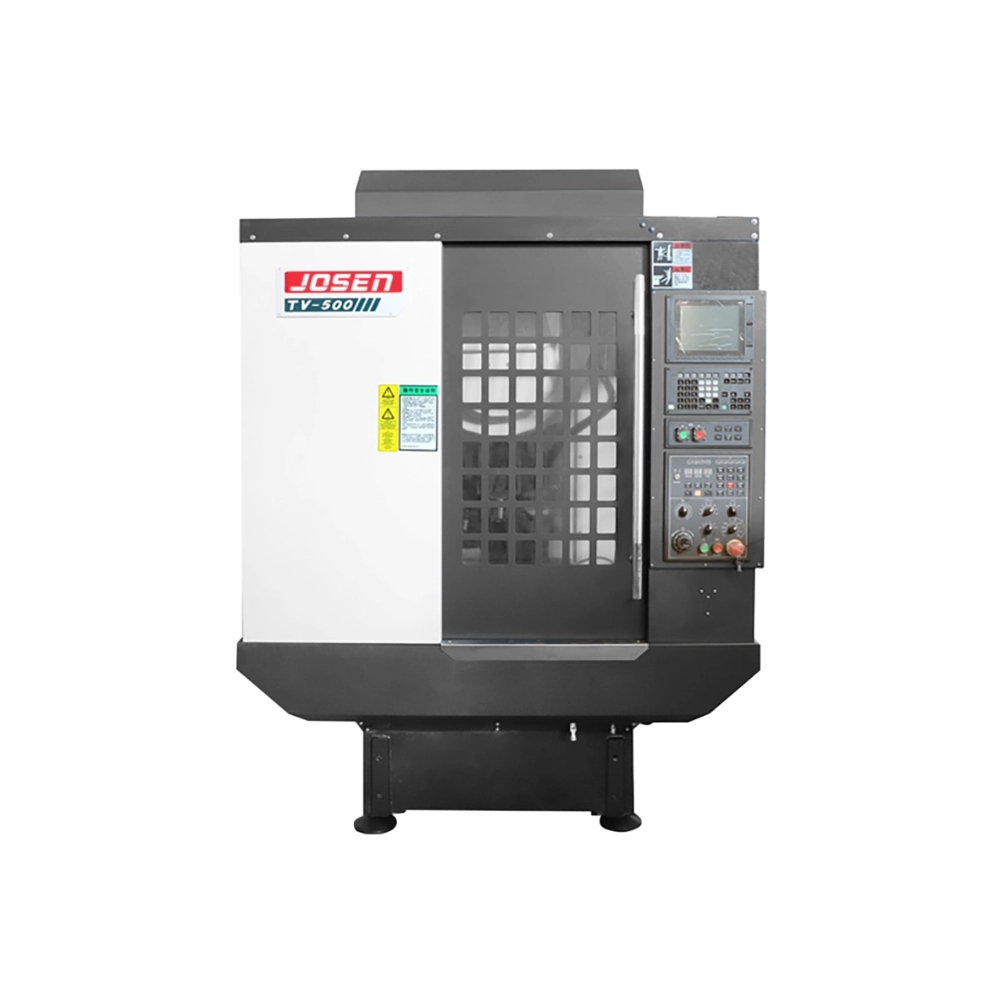
VMC 500 CNC Vertical Machining Center
Contact UsThe machine is suitable for communication, medical equipment, power tools, 3C products processing,etc.Three axes acceleration up to 1G, from standstill to 48m/min, just 0.2 seconds.
-
OPTIMIZING CROSS CUT SAW MAXCUT F18S+SENSIT 005
Contact UsHigh speed optimization Timber cutting optimizing Cross-cut saw and precision cutting
Automation production line. -
Capacity 1800ML Aseptic Bottle Suitable For Krones Machine
Contact UsBottle Volume: 1800ml
Bottle Type: Aseptic-filling bottle
Suitable Equipment: Krones
Packing Method: Standard packing for export. -

PP PE LDPE HDPE Film Recycled Plastic Washing Machine Recycling Production Line For Sale
Contact UsThe recycling washing line is mainly used to recycle all kinds of plastics, such as film, agricultural film, greenhouse film, woven bags and etc. it can also recycle waste plastic bottles such as HDPE, LDPE, PP, etc. Our output ranges from 300 kg to 2000 kg per hour. Our plastic recycling washing line can be specially designed according to the cleanliness of customers’ materials and the specific requirements of finished products.
Reviews
There are no reviews yet.