
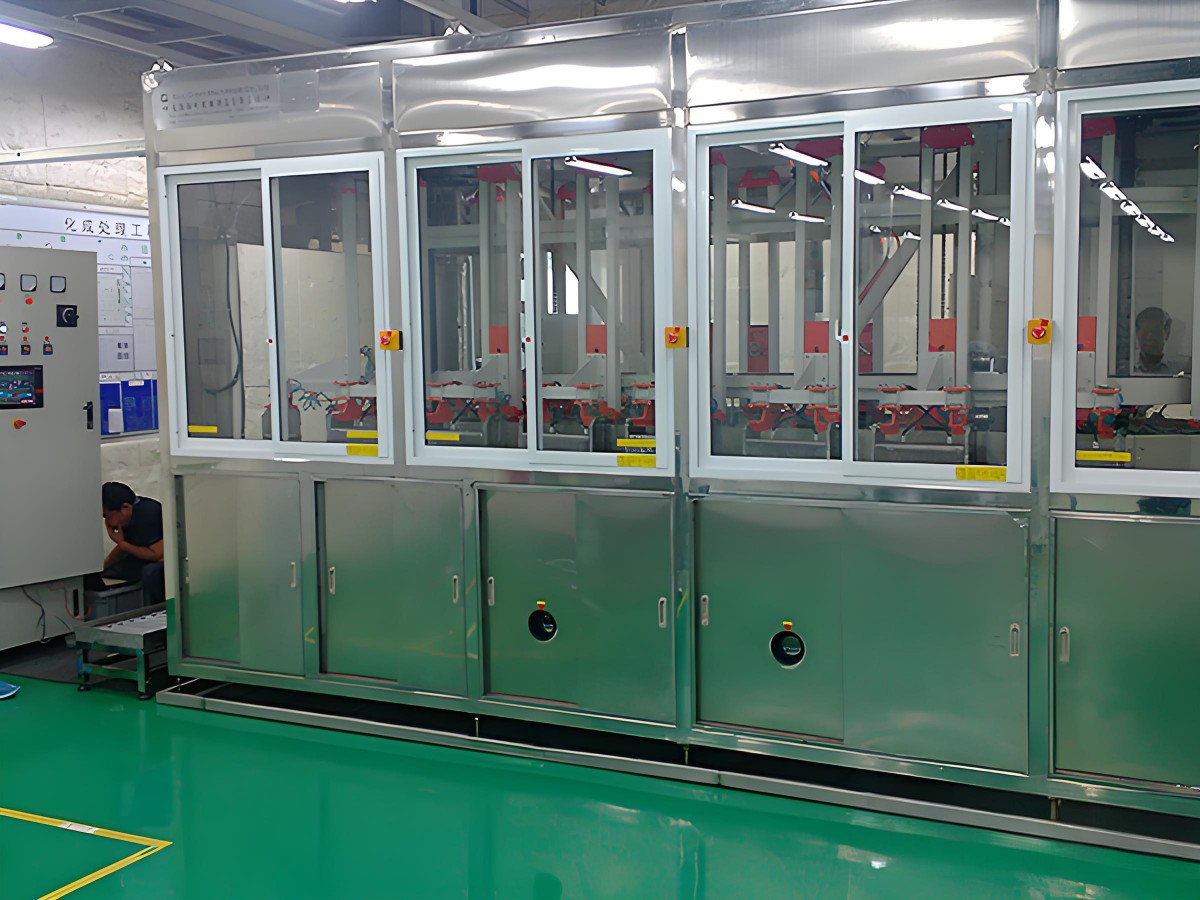
Circular Phosphating Production Line
The Circular Phosphating Production Line, typically referring to an “Overhead Continuous Conveyor” type line, is a mature, high-efficiency continuous automated processing system. Its core is a closed-loop, overhead-installed circular conveyor chain (power & free or similar). Racks carrying the workpieces are suspended from trolleys on the chain. The racks move continuously at a constant speed, sequentially passing through the various process chambers (e.g., enclosed spray tunnels or immersion tanks) arranged below the track. This layout concentrates the process zones under a circular track, offering a compact footprint. It is particularly suitable for medium-volume continuous production with multiple process steps and stable cycle times.
In today's manufacturing environment, efficiency, consistency, and automation are critical factors for maintaining competitiveness. Industries such as automotive manufacturing, household appliances, office furniture, and metal fabrication all require reliable surface treatment processes before painting or coating. One proven solution that continues to deliver outstanding results is the Circular Phosphating Production Line.
Designed around a continuous overhead conveyor system, this type of phosphating line combines high production efficiency with stable processing quality, making it an ideal choice for medium- to high-volume manufacturing facilities.
What Is a Circular Phosphating Production Line?
A Circular Phosphating Production Line is a fully automated surface pretreatment system that uses an overhead continuous conveyor to transport workpieces through a sequence of treatment stages.
The system operates using a closed-loop conveyor chain installed above the processing area. Components are mounted on specially designed racks and move continuously through various process zones, including:
-
Degreasing
-
Water rinsing
-
Surface conditioning
-
Phosphating
-
Drying
Unlike straight-line systems that require significant floor length, the circular layout allows manufacturers to arrange multiple treatment stages within a compact footprint, maximizing factory space utilization.
Industries That Benefit from Circular Phosphating Lines
Because of their efficiency and versatility, circular phosphating production lines are widely used in industries such as:
Automotive Manufacturing
Car body panels, chassis components, brackets, and structural parts can be processed continuously before painting or electrophoretic coating.
Home Appliance Production
Manufacturers of refrigerators, washing machines, air conditioners, and kitchen appliances rely on phosphating lines to improve coating adhesion and corrosion resistance.
Office Furniture Manufacturing
Metal cabinets, filing systems, lockers, and shelving units can be treated efficiently in large production batches.
General Metal Fabrication
Various sheet metal products and fabricated steel components can benefit from uniform surface preparation before finishing.
Key Advantages of Circular Phosphating Production Lines
1. Continuous High-Efficiency Production
One of the biggest advantages of a circular phosphating system is its uninterrupted workflow.
Because workpieces move continuously through the process stages:
-
Production cycles remain stable
-
Throughput increases significantly
-
Manual handling is minimized
-
Overall productivity improves
This makes the system ideal for manufacturers with consistent production schedules.
2. Compact Layout and Space Savings
Factory space is a valuable resource.
The circular conveyor design allows a long treatment process to be folded into a relatively compact area, reducing the overall footprint compared to traditional straight-through lines.
This is particularly beneficial for facilities with limited building length but sufficient floor width.
3. Consistent Processing Quality
Maintaining consistent surface treatment quality is essential for successful coating performance.
With fixed conveyor speeds and precisely controlled process times, every workpiece receives the same treatment exposure, helping ensure:
-
Uniform phosphating layers
-
Better paint adhesion
-
Improved corrosion resistance
-
Reduced quality variation
4. Proven Reliability
Circular phosphating lines have been widely used across industries for decades.
Their mature technology offers:
-
Stable conveyor operation
-
Reliable spray systems
-
Precise temperature control
-
Easy maintenance
Manufacturers benefit from lower operational risks and reduced downtime.
Advanced Technologies Behind Modern Circular Phosphating Systems
Today's circular phosphating lines incorporate several advanced engineering features to improve performance and efficiency.
Precise Conveyor Synchronization
Modern overhead conveyor systems use advanced positioning technology to ensure racks enter each process zone accurately.
This minimizes:
-
Rack sway
-
Product collisions
-
Uneven spray coverage
and helps maintain consistent treatment quality throughout production.
High-Efficiency Spray Tunnel Design
Sophisticated tunnel spray systems utilize:
-
Multi-angle spray nozzles
-
Optimized circulation systems
-
Filtration technology
-
Labyrinth sealing structures
These features maximize chemical utilization while ensuring complete surface coverage.
Environmental and Energy Control
Temperature, humidity, and ventilation are carefully managed throughout the process.
This provides:
-
Stable phosphating performance
-
Better drying efficiency
-
Improved workplace conditions
-
Lower energy consumption
Intelligent Production Integration
Modern phosphating lines can be integrated directly with:
-
Powder coating systems
-
Electrophoretic coating lines
-
Spray painting booths
-
Drying ovens
This creates a fully automated production flow and supports smart factory initiatives.
Circular Line vs. Gantry-Type Phosphating Line
Manufacturers often compare circular systems with gantry-type phosphating lines.
Circular Line Advantages
-
Lower equipment investment
-
Higher continuous production efficiency
-
Compact plant layout
-
Stable processing cycles
Gantry Line Advantages
-
Greater flexibility for oversized workpieces
-
Easier handling of irregular shapes
-
Better adaptability for customized production
The best choice depends on production volume, product size, and future expansion plans.
Managing Water Drip and Cross-Contamination
A common concern in phosphating operations is preventing liquid carryover between process stages.
Modern circular phosphating systems address this through:
-
Drainage transition zones
-
Drip collection trays
-
Air-knife separation systems
-
Negative pressure tunnel designs
These features effectively reduce contamination while improving process cleanliness and chemical efficiency.
Looking Ahead
As manufacturers continue to pursue higher automation levels and improved product quality, circular phosphating production lines remain a valuable solution for surface treatment operations.
Their combination of continuous production, consistent quality, efficient space utilization, and proven reliability makes them particularly attractive for industries requiring large-scale metal pretreatment before coating.
For companies seeking a balance between production efficiency, operational stability, and long-term return on investment, the circular phosphating production line continues to be one of the most effective pretreatment systems available today.
Related products
-
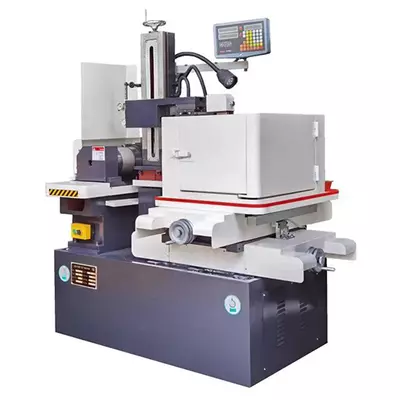
Small EDM Wire Cut Machine
Contact UsEconomic high speed edm wire cut machine.
Main Features:
Roller for X/Y axis, also called hard rail ( V rail);
With ±3° taper as standard, ±15°, ±30°, ±45° as option;
Accuracy: ±0.01/300mm;
Roughness: Ra 1.0-2.5 µm;
Low consumption, material saving. -
Capacity 1258ML Hot Filling Suitable For Krones Machine
Contact UsBottle Volume: 1258ml
Bottle Type: hot-filling bottle
Suitable Equipment: Krones
Packing Method: Standard packing for export. -
Used NSC Schlumberger GN6 Gilling Machine
Contact UsYear: 1986
Spinning production line
Mixed belt: GN6 solid ball forming machine barrel
One needle: GN6 cylinder diameter 700 * 1000mm, 1 head and 1 cylinder, self leveling
Two needles: GN6 cylinder diameter 700 * 1000mm, one head and one cylinder
Three needles: GN6 cylinder diameter 600 * 1000mm, 2 heads and 2 cylinders
According to your requirements, we can transform it into a size suitable for your production needs! -
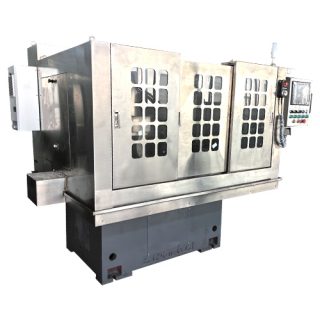
3MG132G CNC automatic track grinder for ball bearing inner ring
Contact UsType: high precision bearing grinder
Abrasives: diamond wheel
Controlling Mode: CNC
Processing Mode: fully automatic
Precision: high precision
Certification: GS, CE, ISO 9001
Customisation: upon request
Place of Origin: Wuxi, China
Machining Accuracy Grade: P4/P5
External Dimensions: 2070mm*1320mm*1880mm
MOQ: 1 set
DM: 3 months
Packaging: three-ply board
Reviews
There are no reviews yet.