
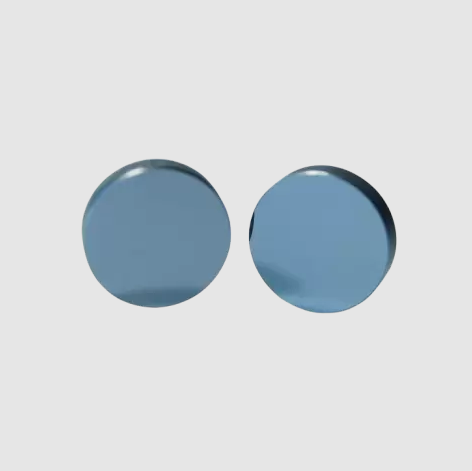
Silicon Lens
Monocrystalline silicon is an infrared optical material with excellent comprehensive cost performance.
Silicon Lens is an infrared optical component manufactured from high-purity monocrystalline silicon. It offers a strong combination of infrared transmission, high refractive index, thermal conductivity, mechanical hardness, and cost efficiency, making it suitable for a wide range of infrared optical systems.
Optical-grade Czochralski silicon (OCZ-Si) is commonly used as a transmission material in the mid-infrared region, particularly around 3–5 μm, where infrared transmittance can exceed 50%.
Zone-melted silicon provides a broader usable spectral range. Depending on purity and material grade, FZ silicon can support applications extending from approximately 1–14 μm, while high-purity float-zone silicon (HPFZ-Si) can be considered for far-infrared applications at wavelengths above 30 μm.
Key Advantages
Broad Infrared Transmission
-
Effective operating wavelength: 1.2–7 μm
-
Particularly suitable for the 3–5 μm mid-infrared band
-
Low absorption within its principal operating range
-
High infrared transmission for optical detection and imaging applications
-
Suitable for infrared lenses and other transmissive optical components
High Refractive Index
-
Refractive index: approximately 3.4
-
High refractive index allows optical designers to achieve the required focusing performance with relatively compact lens geometries
-
Can help reduce the required surface curvature for a given focal length
-
Suitable for systems where optical package size and surface geometry need to be controlled
Lightweight and Hard
-
Density: 2.33 g/cm³
-
Lower density than sapphire
-
Mohs hardness: 7
-
Good mechanical hardness for precision optical component applications
-
Chemically stable under appropriate operating conditions
-
Insoluble in water
High Thermal Conductivity
-
Thermal conductivity: 159 W/(m·℃) at 27 ℃
-
Efficient heat transfer helps dissipate thermal energy
-
Suitable for infrared optical systems exposed to elevated thermal loads
-
High thermal conductivity can help reduce thermal lensing effects in high-power optical applications
Silicon Lens Material Options
Silicon lenses can be produced using different monocrystalline silicon growth technologies according to the required optical performance and wavelength range.
| Parameter | Specification |
|---|---|
| Crystal Structure | Monocrystalline Silicon |
| Growth Method | CZ or FZ |
| Purity | >99.9999% |
| Typical Material | Optical Grade Silicon |
| Application Range | Infrared Optical Systems |
Czochralski Silicon (CZ)
Optical-grade Czochralski silicon is suitable for infrared transmission applications, particularly in the 3–5 μm mid-infrared region.
Float-Zone Silicon (FZ)
Zone-melted or float-zone silicon provides a broader transmission range and is suitable for applications requiring extended infrared spectral performance.
High-Purity Float-Zone Silicon (HPFZ-Si)
High-purity FZ silicon can be used for specialized infrared applications extending into longer wavelengths, including far-infrared applications above 30 μm, depending on material purity and optical configuration.
Optical Specifications
| Optical Property | Value |
|---|---|
| Refractive Index at 3.0 μm | 3.436 |
| Refractive Index at 5.0 μm | 3.426 |
| Thermal Coefficient of Refractive Index at 25 ℃ | 1.50 × 10⁻⁴ |
| Transmission Range | 1.2–10 μm; 50–100 μm |
Actual transmission performance depends on silicon grade, purity, surface condition, optical configuration, and application wavelength.
Thermal Properties
| Property | Specification |
|---|---|
| Thermal Linear Expansion at 25 ℃ | 2.55 × 10⁻⁶ ℃⁻¹ |
| Thermal Conductivity at 27 ℃ | 159 W/(m·℃) |
| Specific Heat Capacity | 0.712 × 10³ J/(kg·℃) |
| Melting Point | 1412 ℃ |
The combination of relatively low thermal expansion and high thermal conductivity makes silicon suitable for optical systems where temperature-induced dimensional and refractive-index changes need to be controlled.
Mechanical Properties
| Property | Specification |
|---|---|
| Density at 20 ℃ | 2.33 g/cm³ |
| Mohs Hardness | 7 |
| Young's Modulus | 1.89 × 10¹⁰ Pa |
| Shear Modulus | 7.99 × 10¹⁰ Pa |
| Poisson's Ratio | 0.266 |
These properties provide a useful balance between low weight, mechanical rigidity, and hardness for precision infrared optical components.
Chemical Properties
| Property | Specification |
|---|---|
| Molecular Weight | 28.09 |
| Solubility in Water | Insoluble |
Silicon offers good chemical stability and is insoluble in water, supporting its use in appropriately designed industrial and optical environments.
Refractive Index vs. Wavelength
The refractive index of silicon varies slightly with wavelength. The following values can be used as reference data for optical design:
| Wavelength (μm) | Refractive Index |
|---|---|
| 1.5 | 3.484 |
| 2 | 3.456 |
| 3 | 3.436 |
| 4 | 3.429 |
| 5 | 3.426 |
| 6 | 3.424 |
| 7 | 3.423 |
| 8 | 3.422 |
| 9 | 3.422 |
Typical Applications
Silicon Lens can be considered for applications including:
-
Mid-infrared optical systems
-
Infrared imaging
-
Thermal imaging systems
-
IR detection equipment
-
Infrared sensing
-
High-power infrared optical systems
-
Spectroscopy
-
Industrial infrared instrumentation
-
Optical components operating in the 3–5 μm band
-
Specialized far-infrared systems using high-purity FZ silicon
Product Selection Considerations
For B2B optical component procurement, silicon lens selection should be based on the complete optical system requirements rather than wavelength alone.
Key factors include:
-
Required operating wavelength
-
Transmission range
-
Silicon growth method: CZ or FZ
-
Material purity
-
Refractive index
-
Thermal environment
-
Required optical performance
-
Lens geometry
-
Surface quality
-
Dimensional tolerances
-
Coating requirements
-
Application power level
For systems operating at longer infrared wavelengths, the silicon grade and purity should be evaluated carefully because material quality can directly influence transmission performance.
Silicon Lens for Infrared Optical Systems
With a high refractive index of approximately 3.4, a density of 2.33 g/cm³, high thermal conductivity, and strong mechanical hardness, monocrystalline silicon provides a practical material platform for infrared optical components.
The choice between CZ silicon, FZ silicon, and HPFZ-Si should be determined by the required wavelength range and optical performance. For conventional mid-infrared applications, optical-grade CZ silicon can provide a cost-effective solution, while FZ and high-purity FZ silicon are suitable for applications requiring broader or extended infrared transmission.
Related products
-

Black Currant Juice Powder
Contact UsLatin Name: Ribes nigrum L.
Synonyms:
Part of Used: Fruit
Specifications: Freeze-dried, 80mesh; Freeze-dried, 80mesh
Appearance:
Application: Food Supplements,Nutritional Supplement, Functional Food, Beverages/Solid Beverage -
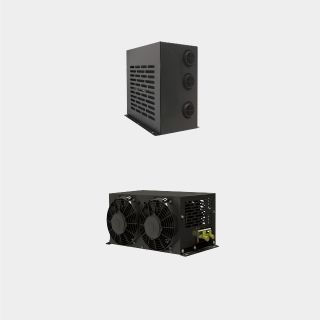
Air conditioner ducted Powerful units with high cooling and heating capacity K48UFR-725P
Contact Us● Powerful units with high cooling and heating capacity
● Lightweight design, intelligent design
● Longer battery life, meeting the need for a full night’s sleep
● Energy saving/lightweight/quiet
● Split structure, bottom mounted
● Energy saving and low consumption, quality assurance
● The company has passed the automotive industry IATF16949 certification -
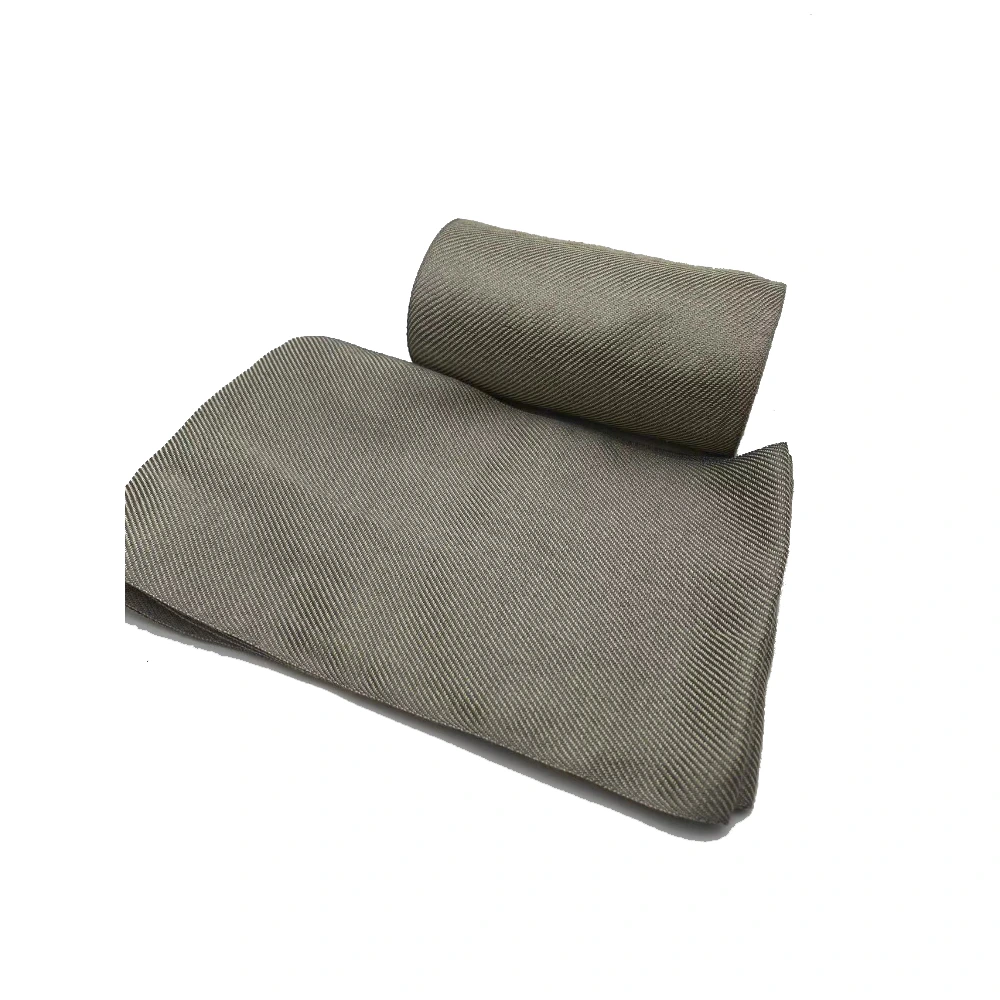
Metal cloths
Contact UsYancheng Zhongming New Materials Co., Ltd. is located in Yancheng City, Jiangsu Province.
-
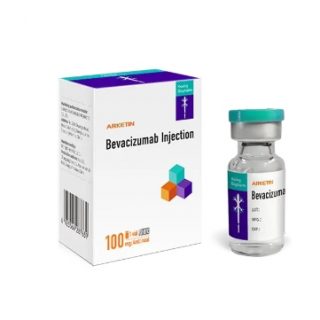
Bevacizumab Injection
Contact UsBevacizumab, an anti-vascular endothelial growth factor monoclonal antibody (anti-VEGF mAb)
Reviews
There are no reviews yet.