
Shuttle vs Drive-In for Frozen Food Warehouses: The Real Cost Gap After Year 3
Published: November 2026, Nanjing, China — Nanjing Tianbo Storage Systems Co., Ltd. (TB), a factory-direct manufacturer of both drive-in and radio shuttle systems with ISO 9001 certification
Published: November 2026 | By TB Engineering Team
Every frozen food operator building deep-lane storage eventually runs the same debate, and most suppliers settle it with a brochure. Here is the honest version instead: in radio shuttle vs drive-in racking for frozen food warehouse projects, drive-in wins the Day 1 price and shuttle systems win every year after Year 3 — provided your lanes actually turn fast enough to earn their keep.
Because TB (Nanjing Tianbo Storage Systems Co., Ltd.) manufactures both systems under one ISO 9001 roof, we have no horse in this race — only the five-year ledger from factory-direct cold-chain projects, which is what follows below — including the full shuttle vs drive-in cost comparison freezer buyers should run before signing anything. Both systems roll off the same Nanjing production lines, so this comparison comes from production data rather than product marketing.
1. Radio Shuttle vs Drive-In Racking for Frozen Food Warehouse: The Year 1 Ledger
On Day 1, drive-in is cheaper — typically $150–300 per pallet position against $250–450 for shuttle lanes with cars included. If your question ends at purchase price, the debate ends here. But frozen food storage has a habit of making Year 1 the least interesting year, and the difference starts with physics.
Drive-in stores pallets by driving a forklift inside the rack lane, at height, in a −20 °C aisle where steel has lost part of its impact toughness and a 3-ton pallet swings on every entry. Every lane entry is a chance to strike an upright, and the guide rails that protect the uprights get abraded season after season. A shuttle system removes the forklift from the lane: the truck only touches the pallet at the lane face, and a battery-powered shuttle car does the work inside. The car can dent a beam; it cannot collapse a lane. That single difference rewrites the maintenance budget:
✅ Drive-in damage reality: upright and brace repairs in cold stores commonly run $300–800 per event including crane time and re-inspection, and high-traffic drive-in lanes collect several events a year.
✅ Shuttle damage reality: lane structure sees near-zero traffic damage; costs shift to shuttle car maintenance — batteries, wheels, sensors — which is planned, cheap and spare-part priced.
✅ Labor: a shuttle operator drops pallets at the lane face while the car works inside — handling time per pallet typically falls 30–60% versus drive-in entry, and driver training time for precision lane entry disappears.
✅ Bottom line: drive-in buys density with labor and repair exposure; shuttle buys the same density with capital instead. Year 1 only prices the capital.
2. Shuttle vs Drive-In Cost Comparison After Year 3: The Ledger Flips
Run the shuttle vs drive-in cost comparison freezer buyers actually face — five years, not five weeks — and the crossover appears for any lane turning more than roughly 15–20 pallets per day. Three lines drive it. First, repairs: a busy drive-in freezer spending even $4,000–8,000 a year on impact repairs is quietly paying for a shuttle fleet. Second, labor: at 25 pallets per lane per day, the handling minutes saved per pallet compound into a full operator shift across a warehouse of lanes. Third, FIFO: drive-in is last-in-first-out by construction, which forces frozen-food operators into workarounds for date-coded product, while shuttle delivers true FIFO in the same deep lanes.
There is also an energy line most comparisons miss. Shuttle lanes tolerate greater depth without worker access, so the same pallet count fits in fewer, longer lanes — the utilization gain translates directly into less refrigerated envelope, worth 25–40% on the freezer energy bill in typical conversions. Add it up and the 5-year total cost of ownership favors shuttle for throughput-heavy frozen food; drive-in keeps winning only where lanes turn slowly and batches run LIFO anyway.
Put numbers on a 2,000-position, −20 °C frozen protein warehouse. The shuttle premium over drive-in is roughly $200,000 on Day 1. Against it: $5,000–7,000 a year in avoided drive-in impact repairs, one shifted operator role as handling time drops by a third, and 10–15% off the freezer energy bill from the denser envelope — call it $70,000–90,000 a year at typical tariffs. The crossover lands between Year 2 and Year 3, and everything after is margin. Slow lanes in the same building? Leave them drive-in — a mixed-system order ships from one factory as easily as a single-system one.
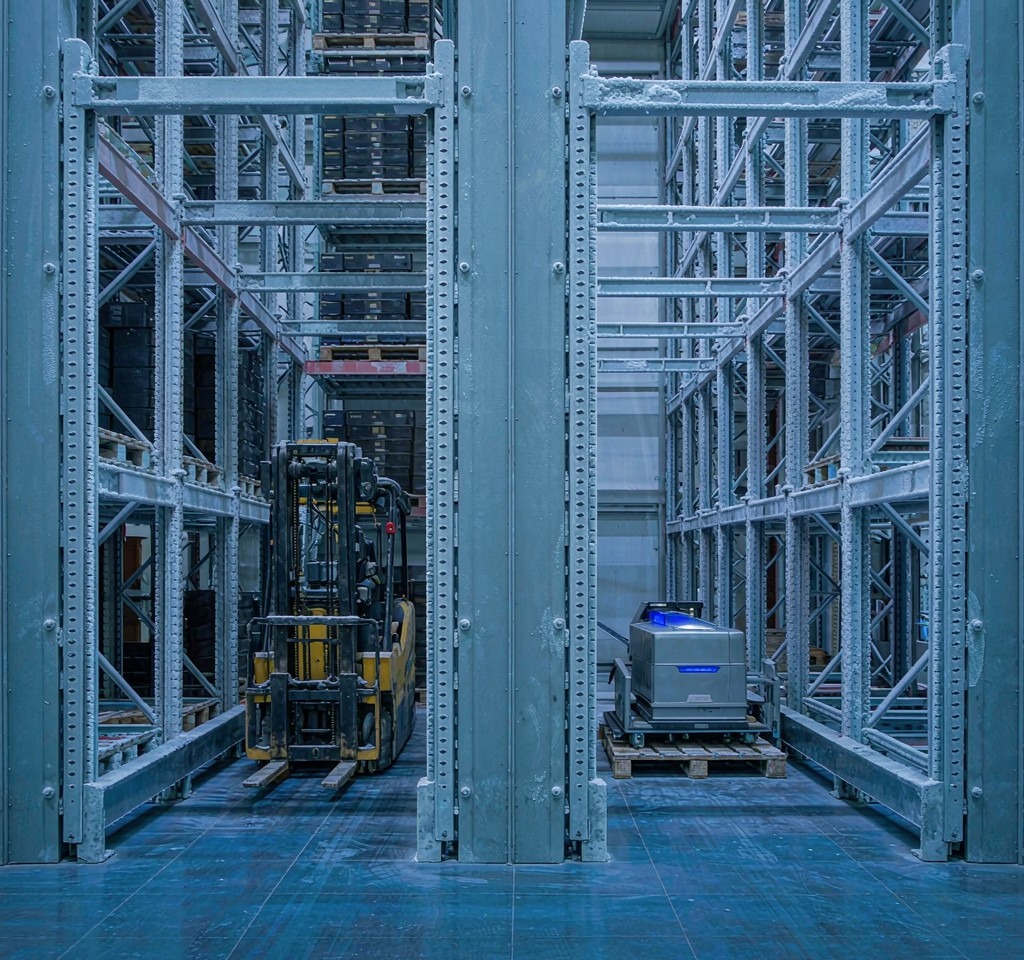
✅ Bottom line: below ~15 pallets per lane per day, buy drive-in and pocket the difference. Above it, shuttle's premium repays itself in repairs, labor and energy — and keeps paying through Year 10.
Frequently Asked Questions
Q: Which is better drive-in or shuttle in cold storage for slow-moving SKUs?
A: Drive-in. For long-term block storage of a single SKU per lane — aged frozen stock, strategic reserves, seasonal overflow — LIFO is harmless and the lower capital cost is pure savings. The shuttle's advantages only activate with turnover: if lanes turn fewer than 5–10 pallets a day, even the maintenance argument fades.
Q: How many shuttle cars does a frozen food warehouse need?
A: In any radio shuttle vs drive-in racking for frozen food warehouse upgrade, car count comes from throughput data, not ratios. A cold-rated shuttle car sustains 20–25 pallets per hour, so the rule of thumb is one car per 2–4 active lanes depending on lane depth and daily turnover. TB sizes the car count from your actual throughput data, not from a ratio table — and supplies cold-rated batteries as standard for freezer fleets.
Q: Can an existing drive-in installation be upgraded to shuttle operation?
A: Often, yes. Most drive-in structures accept shuttle rails with minor modifications, converting the damage-prone lanes while keeping the steel. As a factory-direct OEM/ODM manufacturer, TB regularly supplies retrofit assessments, rails and cold-rated shuttle cars for third-party drive-in installations.
Want the five-year ledger for your own lanes? Send TB (Nanjing Tianbo Storage Systems Co., Ltd.) your lane count, turnover and temperature zones. Which is better drive-in or shuttle in cold storage is a data question, and our engineers will return a free side-by-side TCO comparison that answers it from your own numbers — factory-direct, from a manufacturer that builds both systems and has no reason to sell you the wrong one.
Related products
-
-
Dual station factory test bench
Contact UsThe motor factory test bench, model ZY4800A-2, is a comprehensive test bench for production line general inspection and testing equipment.
-

Metal casings
Contact UsYancheng Zhongming New Materials Co., Ltd. is located in Yancheng City, Jiangsu Province.
-
Infliximab for Injection
Contact UsEfficacy and safety are equivalent to the original drug (Johnson & Johnson/Merck & Co.
Reviews
There are no reviews yet.