

PTC Heater Cold Resistance: Why It Decides Inrush
Self-limiting PTC heaters for enclosures, appliances and liquids: dry-burn below 280 °C, 5–240 V, 28 models, ISO 9001 / CQC / CE / SGS.
PTC Heater Cold Resistance: Why It Decides Inrush
Every PTC heater has a resistance value that exists for only a moment: the resistance it has before it has warmed itself. It is the lowest value the element will ever show, it lasts a few seconds, and it decides the fuse, the relay, the connector and the breaker behind it.
What cold resistance is
Measure a PTC element at room temperature, disconnected and settled, and you read its cold resistance. It is the bottom-left end of the R–T curve: as the element warms, resistance climbs steeply and the power it draws falls. Cold resistance is therefore the highest current the part can ever ask for — nothing later in its life comes close.
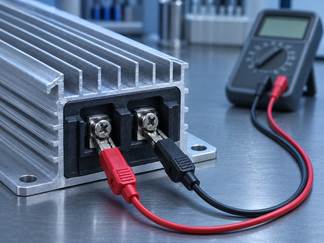
Read cold, and read it disconnected: probes on the terminals, lead resistance nulled out, ambient temperature noted next to the value.
Inrush, in numbers
Switch on and the element is at that lowest resistance, so current spikes to V/R_cold before the ceramic heats. On our 6578 at 220–240 V the inrush reaches about 2,000 W / 9 A against a running figure near 1,000 W — roughly twice the steady current, gone in seconds.
That ratio is a property of the material and the setpoint, not a defect. It also explains two symptoms technicians report: a fuse that fails on a cold morning, and a breaker that trips when several heaters start at once.
The ceiling on power
Because cold resistance is the lowest resistance the element has, V²/R_cold is the highest power the part can ever draw. That is the asymptote of the power-airflow curve: however hard the element is cooled, it cannot exceed the cold-resistance limit. Cooling moves the operating point toward that ceiling but never past it, which is why a 1,000 W airflow rating and a 2,000 W inrush are consistent statements about the same part.
Why tolerance matters more here than anywhere else
A ±5% tolerance on cold resistance becomes ±5% on every figure measured at that point, and it shifts where the curve starts to saturate. Two units from the same batch reading 24 Ω and 27 Ω will not draw the same current at switch-on, so a fuse chosen against the nominal value can be marginal on the low-resistance unit.
That is the practical reason to ask a supplier for cold resistance with its tolerance and the temperature it was measured at, rather than for a single wattage.
Designing protection around it
· Fuse. Sized above the inrush but below the fault current. A slow-blow type rides through the spike that a fast fuse would read as a fault.
· Relay or contactor. The inrush rating — often two to three times the continuous one — matters more than the steady rating.
· Wiring and connectors. The cold-start current sets conductor and terminal size, not the running current.
· Shared breakers. Several heaters starting together add their inrush; stagger the switch-on if the supply is marginal.
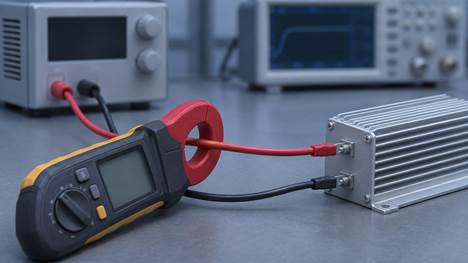
The first seconds after switch-on: a clamp on the supply lead sees the cold-resistance peak — roughly twice the running current, and gone again before the element warms.
Measuring it properly
Disconnect the heater, let it settle to ambient, and measure across the terminals with a meter that resolves a few tenths of an ohm — subtracting lead resistance, or zeroing it first. Record the ambient temperature alongside the value: the number drifts with temperature, and a reading taken straight after a run is not a cold reading at all.
What we publish
Our datasheets give cold resistance with its tolerance and reference temperature, the R–T curve, and the inrush figure at the rated voltage. Those three let a customer size the electrical protection once, instead of discovering it on the first cold morning.
A worked example
Take a 230 V element with a cold resistance of 25.5 Ω. At switch-on it draws 230 ÷ 25.5 ≈ 9 A, about 2,070 W. Once the ceramic reaches working temperature its resistance has roughly doubled, to 53 Ω, and the same element draws 4.3 A — about 1,000 W. Nothing in the part changed except its own temperature, and the supply never sees the 1,000 W figure unless the heater is already hot.
The short answers
· Why does cold resistance matter? It sets the inrush current, the fuse and relay ratings, and the maximum power the element can ever draw.
· Why does my heater blow fuses at start-up? Because a cold element draws roughly twice its running current for a few seconds.
· Can I measure it with a normal multimeter? Yes — with the heater disconnected, at ambient, and with lead resistance subtracted.
· Does cold resistance change with age? Slightly. Element and contact resistance drift, so a heater that has run for years reads a little higher; a large jump usually means a failing connection, not a worn element.
Ask for the cold resistance of any model you are evaluating, with its tolerance and the temperature it was measured at.
Related products
-

FR5 epoxy fiberglass laminate
Contact UsFR-5 glass epoxy is similar to FR-4 but is designed for higher operating temperatures. It is able to keep its insulating..
-
BM210A
Contact UsThe BM210A is a high-performance Battery Management System (BMS) designed for lithium battery packs.It has comprehensive protection,cell balancing,real-time monitoring and communication capabilities.
-

FR4 epoxy fiberglass laminate
Contact UsFR-4 glass epoxy is a laminate sheet made from a woven fiberglass substrate and a flame-retardant epoxy resin.
-

GF-AB02 Thermal Gel
Contact UsZS-GF-AB30 is a kind of appearance paste two-component molding high thermal conductivity silicone gel, can be heated curing, with the characteristics of the higher the temperature the faster the curing. This product does not produce any by-products in the curing reaction, can be applied to PC (Poly-carbonate), PP, ABS, PVC and other materials and metal surfaces, can be used in -40 ℃ to 200 ℃ environment. It can be used in the environment from -40℃ to 200℃. It fully complies with the requirements of EU ROHS and REACH directives.
Reviews
There are no reviews yet.