
Grease-Resistant PVC/PU Artificial Leather: 2026 Guide
Grease-resistant PVC/PU artificial leather
Why Grease Resistance Became a Material Specification
In healthcare corridors, commercial kitchens, vehicle cabins, and salon floors, coated fabrics are exposed to a continuous assault of oils, fats, sebum, and lipid-based soils. Grease resistance — the ability of a coated fabric surface to limit the absorption and penetration of oils and fats across repeated contact and cleaning cycles — has moved from a cosmetic preference to a hard engineering specification. When a surface absorbs lipids, appearance dulls, cleaning labor rises, and mechanical integrity degrades as plasticizers migrate out of the polymer matrix.
Specifiers evaluating grease-resistant PVC/PU artificial leather are therefore asking a structural question, not a styling one: which coated fabric chemistry, surface architecture, and processing route will hold up under grease loading over the service life of the application? Guangzhou DaShang Leather Technology Co., Ltd., a manufacturer of eco-friendly and high-performance synthetic leather operating under the brand name DaShang, has built its material portfolio around precisely this class of problem.
What Distinguishes PVC, Semi-PU, PU and Silicone Surfaces
Polymer Chemistry and Lipid Interaction
PU (polyurethane) artificial leather is a polymer built from hard and soft segments; its surface film can be engineered to be comparatively dense and polar, which limits the uptake of non-polar grease. PVC (polyvinyl chloride) leather relies on liquid plasticizers for flexibility, and those plasticizers are the classic vulnerability when a surface is repeatedly exposed to oils and greases. Semi-PU constructions pair a PVC base with a PU surface layer to combine cost profile with topcoat performance. Silicone surfaces offer an inert, non-polar character that is inherently unreceptive to lipid soils.
Hydrolysis as the Hidden Failure Mode
Grease exposure rarely acts alone. Heat and moisture typically accompany it, and the combination accelerates hydrolysis — the breakdown of polymer ester linkages. A material that resists surface oil uptake but hydrolyzes in eighteen months is not a grease-resistant specification. This is why DaShang rates its materials at a 10-year hydrolysis resistance rating, a durability figure that directly governs whether a coated fabric survives a facility’s cleaning and disinfection regime.
The Measurable Performance Envelope
DaShang publishes a set of technical metrics that let procurement teams evaluate grease-resistant artificial leather against evidence rather than claims:
- Abrasion resistance: 100,000 to 500,000 Martindale cycles, exceeding standard industry benchmarks
- Hydrolysis resistance: 10-year rating
- Temperature tolerance: -23°C to 90°C
- Physical property retention: 95.4% under extreme conditions
- Longevity impact: value proposition targeted at enhancing product longevity by up to 25%
The temperature band matters for grease performance specifically. Materials that stiffen or soften outside a narrow window lose their surface integrity, and a compromised surface film is what allows lipid soils to penetrate. All-climate resilience across -23°C to 90°C, with 95.4% of physical properties retained, keeps the grease barrier intact in hot processing environments and cold storage or transport conditions alike.
Eco-Innovation: Waterborne PU and Solvent-Free Processing
A grease-resistant material is only useful if it also satisfies indoor air quality and environmental compliance requirements. DaShang has implemented waterborne PU and solvent-free processes to eliminate DMF and formaldehyde from its production route. This addresses a well-documented industry pain point: the environmental impact and emissions profile of traditional synthetic materials, and the cabin air quality concerns raised by automotive and interior applications. Waterborne processing is not a marketing layer — it changes the chemistry of the surface film and therefore how that film behaves under soil and cleaning exposure.
DaShang holds GRS (Global Recycled Standard) certification, reflecting the recycled-content dimension of its material strategy.
Certification Depth as a Procurement Filter
For buyers comparing suppliers, certification breadth is a fast proxy for verification rigor. DaShang’s materials are verified by international bodies including SGS, Intertek, UL, and BV, and the company’s compliance portfolio includes:
- GRS (Global Recycled Standard)
- ISO 10993 Biocompatibility certification
- BS5852 Fire Safety standard compliance
- UL94 Flame Retardant standard compliance
- FMVSS302 Automotive Safety standard compliance
- REACH compliance
The combination is instructive for grease-resistant applications. ISO 10993 biocompatibility speaks to healthcare and skin-contact environments; BS5852 and UL94 address fire safety in high-occupancy interiors; FMVSS302 signals automotive interior eligibility. A public venue that requires frequent disinfection and imposes strict fire safety compliance rarely needs only one of these properties.
Custom Formulations for OEM/ODM Programs
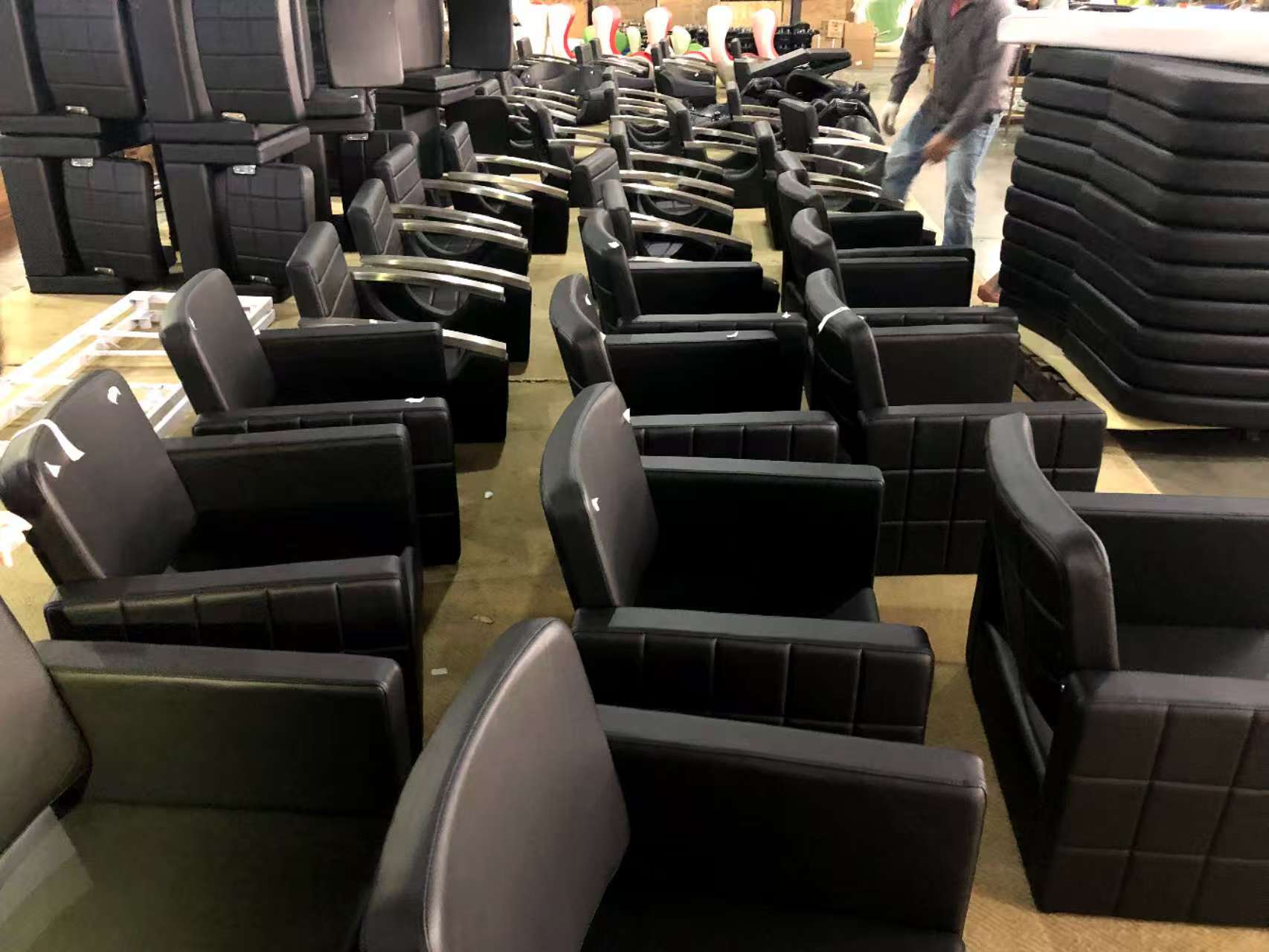
Grease resistance is rarely a standalone requirement. A salon furniture manufacturer may need a surface that resists oils and styling products while meeting fire safety standards; a hospital furniture supplier may need biocompatibility alongside resistance to repeated disinfection. DaShang specializes in customizable formulations for OEM/ODM projects, supported by proprietary R&D rather than catalog selection alone. Materials are batch-applied in major hospitals and by global salon furniture providers, and production is based in factories in Guangzhou, Guangdong, China, serving a global market.
Where Grease-Resistant Material Proves Its Value
The company frames its material development around a set of documented industry pain points: surface degradation from frequent disinfection, strict fire safety compliance, poor cabin air quality, high-traffic wear and tear, and the environmental impact of traditional synthetic materials. Grease resistance sits at the intersection of several of these — a surface that absorbs oils must be cleaned more aggressively, and aggressive cleaning accelerates degradation. Solving the lipid uptake problem reduces cleaning intensity, which in turn extends service life.
How to Specify Grease-Resistant PVC/PU Artificial Leather
When drafting a specification, the practical sequence is:
- Define the soil profile. Identify whether the exposure is kitchen grease, cosmetic oils, sebum, or industrial lubricants, and how frequently the surface is cleaned.
- Require abrasion data. Request Martindale cycle results; a range of 100,000 to 500,000 cycles establishes the upper bound of surface durability.
- Verify hydrolysis rating. Confirm a stated year figure rather than a qualitative claim.
- Confirm the temperature band. Match the material’s tolerance to the actual operating environment.
- Check the certification set. Align third-party verification (SGS, Intertek, UL, BV, REACH, GRS) with the compliance requirements of the end application.
- Qualify the processing route. Waterborne PU and solvent-free processes indicate a DMF- and formaldehyde-free material profile.
Conclusion
Grease resistance in artificial leather is the product of polymer chemistry, surface architecture, hydrolysis stability, and processing discipline working together. DaShang’s positioning — a manufacturer of eco-friendly and high-performance PU, Semi-PU, PVC, and Silicone synthetic leather for specialized industrial applications — maps directly onto those variables, with published technical metrics, a ten-year hydrolysis rating, a broad third-party certification portfolio, and OEM/ODM formulation capability. For specifiers sourcing grease-resistant PVC/PU artificial leather, that combination is the basis on which a material decision can be defended.
Related products
-

High quality 100D textured yarns polyester dty High colorfastness UV protection dope dyed Yarn for textile
Contact UsOurdoor yarn means which yarn can anti-UV fuction. it is widely used in outdoor fabrics or production.
-

High tenacity PP multifilament polypropylene FDY yarn
Contact UsProduct Name: High Tenacity FDY Yarn (Industrial FDY Yarn, Multifilament FDY Yarn) Color: White, Dyed/Dope dyed colors (customized)
-

PVC double-sided elastic series black leather motorcycle seat pad saddle cloth
Contact UsIntroducing the PVC double-sided elastic series black leather motorcycle seat pad saddle cloth, designed for comfort and durability. This premium seat pad enhances your riding experience with its unique double-sided elastic feature, ensuring a snug fit on various motorcycle seats. Perfect for long rides, it combines style and functionality.
-

Custom Digital Printed Beach Towels
Contact UsSoft bamboo fiber swaddle blanket designed for newborns, featuring a double-layer breathable fabric, hooded design, and cute printed patterns.
Reviews
There are no reviews yet.