
Why Auto Buyers Now Send Drawings, Not Part Numbers
Ruian, Zhejiang, December 2026 — As vehicle platforms split into more low-volume derivatives, Ruian City Dongfeng Auto Standard Parts Co., Ltd.
RUIAN, Zhejiang, December 2026 — Automotive fastener catalogues are getting shorter and drawings are getting longer. As vehicle platforms fragment into more derivatives and more low-volume variants, a Tier-1 or Tier-2 buyer increasingly cannot find the exact bolt, stud, plug or pin in a standard range, and ends up issuing a drawing instead of a part number. Ruian City Dongfeng Auto Standard Parts Co., Ltd., a fastener and small machined-parts maker in Tangxia Town that has run an IATF 16949:2016 certified system since its conversion to a joint-stock company in 1995, has built its order book around that shift: standard and non-standard automotive fasteners produced to Q, GB, DIN and ANSI requirements, and to customer drawings.
The company's own history explains the range. Founded in 1983 as a collective enterprise under the municipal township-enterprise bureau, it moved to joint-stock ownership in August 1995, and today operates from a 5,000 m² plant with 15,000 m² of buildings, more than 100 staff, registered capital of RMB 11.98 million and RMB 50 million in fixed and working capital. Its product list runs from high-strength bolts, studs, screws, cylindrical pins, washers and keys to oil-passing bolts, transmission plates and screw plugs — plus the small machined parts that surround them.
A drawing is a specification, not a part
The difficulty with custom fasteners is not that they are unusual. It is that a drawing fixes only the part, while the process determines whether the parts in bin 400 still match the parts in bin 1. Dongfeng's production sequence is therefore published as one chain rather than as separate services: mould making, wire-material modification, cold forming, thread rolling, precision machining, heat treatment, automatic screening and packaging.
Two links in that chain decide most of the outcome. Cold forming sets the under-head fillet radius and the grain flow; a heading tool that is worn, or a wire lot that runs hard, will show up later as a crack that no gauge catches. Heat treatment sets the property class, and it is also where hydrogen can enter the part. Thread rolling after heat treatment, rather than cutting, leaves the thread fibres continuous — which is why the sequence order is worth asking about in a supplier audit, and why a quotation that promises "same as sample" without naming the sequence is answering a different question.
Inspection follows the process, stage by stage
The inspection plan at Dongfeng is organised by production stage, and each stage carries its own instruments — a detail that matters more than the list of equipment itself.
| Stage | What is checked | With what |
| Cold heading | Dimensions, under-head fillet radius, appearance | Caliper, micrometer, image measuring instrument, projector, dial indicator |
| Thread rolling / tapping | Thread dimensions and fit, thread laps, appearance | Ring and plug gauges, micrometer, metallographic microscope after pickling |
| Heat treatment | Hardness and property class, tensile performance, microstructure | Brinell, Rockwell and Vickers testers, tensile machine, metallographic microscope (HRC / HV recorded) |
| Surface treatment | Coating thickness, thread fit, friction coefficient, corrosion, hydrogen embrittlement, appearance | Film-thickness gauge, ring and plug gauges, friction coefficient instrument, torque wrench, salt spray chamber |
| Before packing | Dimensional and cosmetic screening of the lot | Optical screening stations; spectrometer on incoming material |
That spread is what a drawing-based order actually buys: not a certificate on the wall, but a measurement at every transition where the part's properties can change.
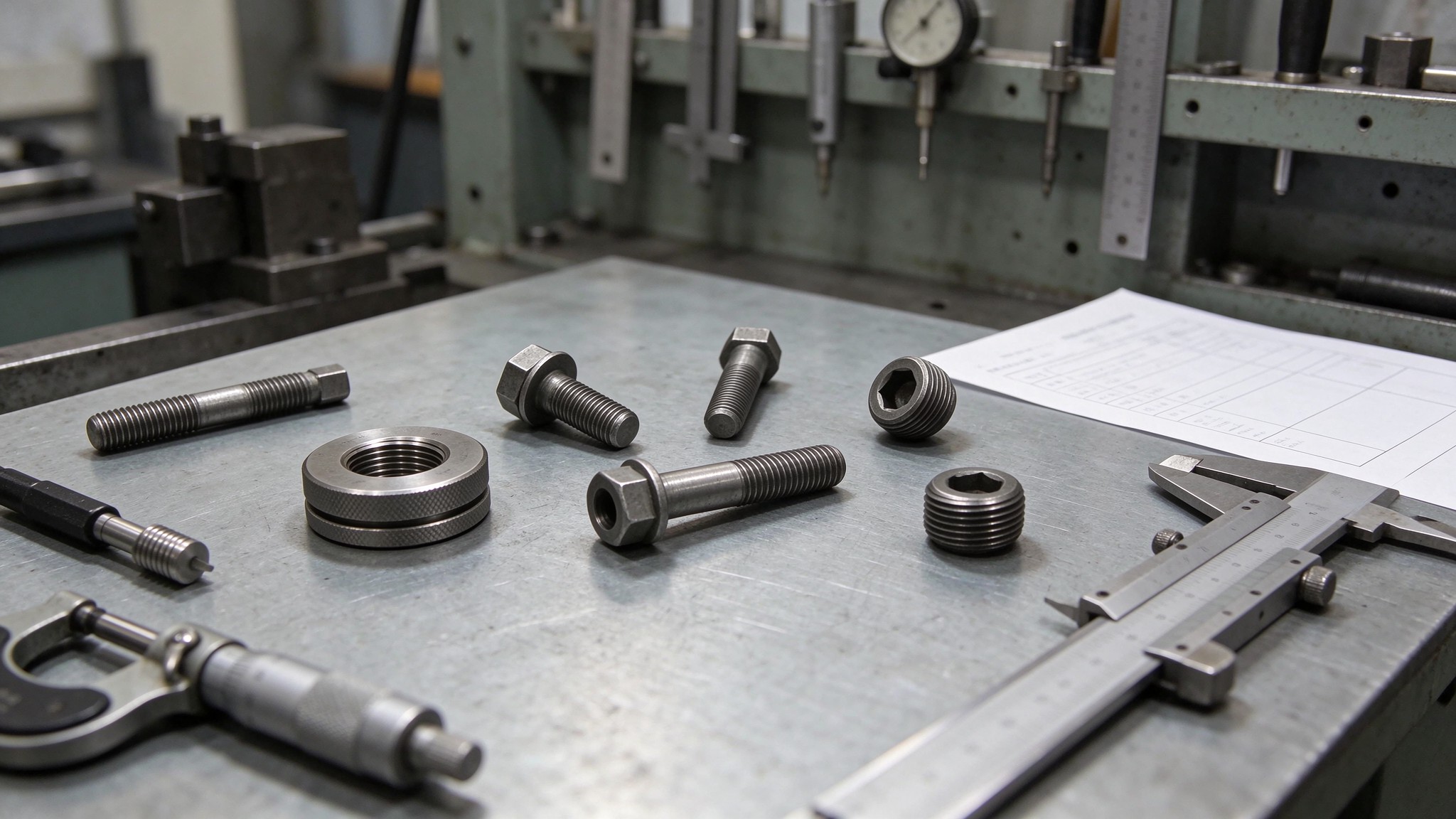
A lot on the inspection plate: thread gauges, micrometer and caliper beside bolts and plugs, with the record sheet filled in against each dimension.
Where the money goes
Custom fastener programmes usually overrun in one of three places, and none of them is the metal.
Mould and tooling is the first. A non-standard head, a flange with a specific bearing face, a shoulder with a defined transition — each needs a die or a tool that is built before the first part exists, which is why the first article, not the volume price, is the expensive item.
Heat treatment and screening is the second. A property class above the standard range pulls the whole lot into a furnace cycle with its own fixture and its own test coupons, and every lot then needs hardness, tensile and structure checks before it can be shipped. Automatic optical screening is the third; it is the only way to hold a cosmetic and dimensional spec across hundreds of thousands of pieces without adding inspectors.
The practical consequence for a buyer is that the cheapest quote is often the one that has not priced the sequence. A supplier that quotes a custom bolt, a heat-treated stud and a coated plug at catalogue prices is either expecting to substitute the process or planning to discover the difference later.
The parts that keep recurring
Within that range, five product families come up most often in automotive and machinery enquiries:
-
Transmission plates — used between the transmission and the drive axle in off-road vehicles, between the transmission and the transfer case, and on certain steering shafts, where a universal drive arrangement simplifies the layout of the steering mechanism.
-
Screw plugs — sealing rather than fastening: transmission oil-change ports, engine oil-change ports, the many oil ports on construction machinery, and cast-port closures after machining.
-
Double-end studs — for joints where one member is too thick to drill through, or where the structure has to stay compact.
-
Oil-passing bolts — sealing threaded through-holes on diesel fuel, oil, water and gas lines.
-
Precision lock nuts — supplied across the structural forms used in machine tools, textile and printing machinery, centrifuges and turbo compressors, air-conditioning, land and offshore equipment, transport, aviation, marine and nuclear applications, agriculture and food machinery, and construction plant.
The applications the company lists for its output as a whole are broader still: chassis, engines, construction machinery, agricultural machinery, general machinery, and marine generators and engines.
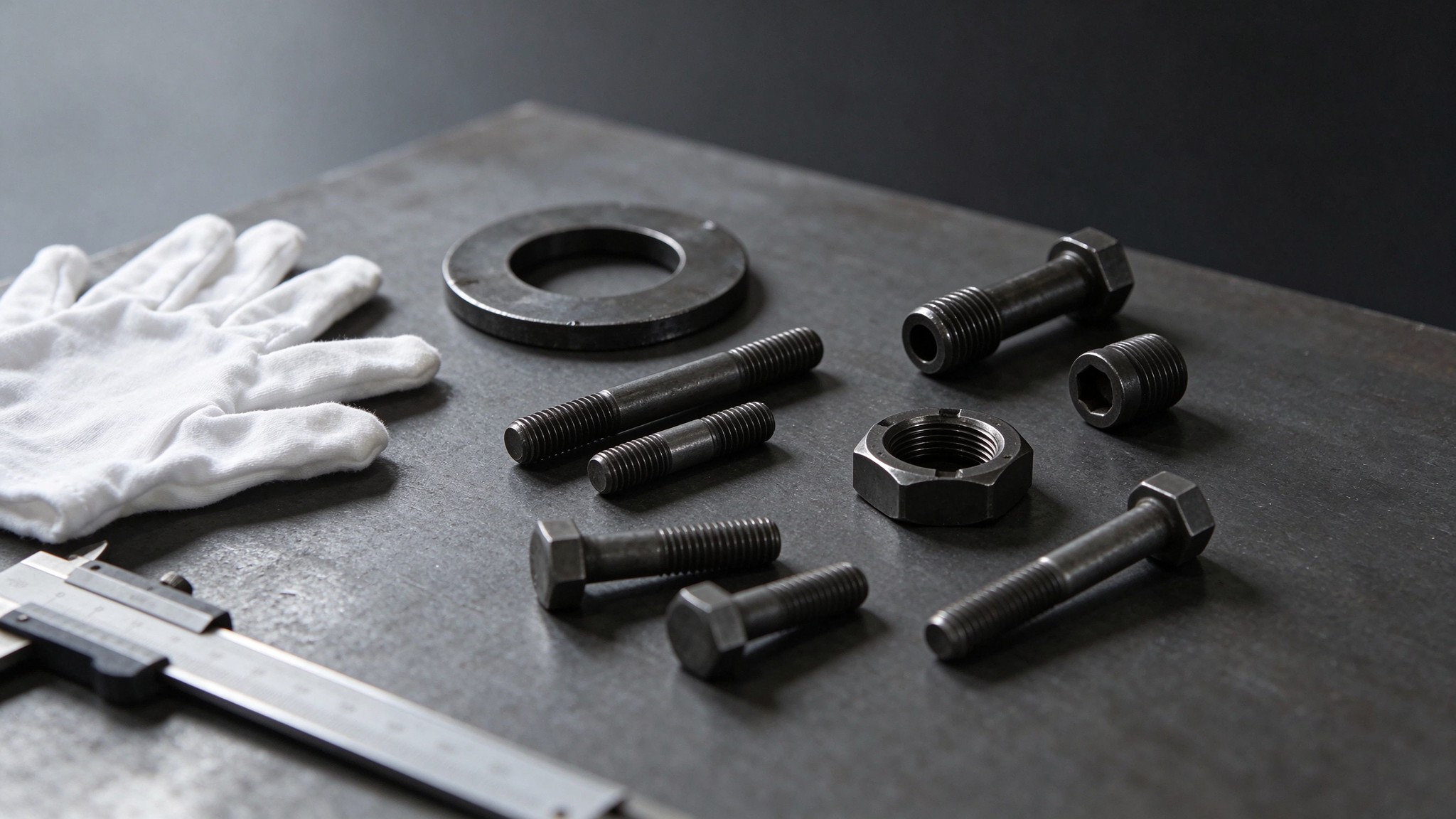
The mix that arrives as drawings rather than part numbers: plate, studs, hollow bolt, socket plug, lock nut and hex bolts, with a caliper for scale.
What to put in a drawing-based enquiry
Custom fastener orders are lost at the enquiry stage far more often than at the machine. The list that prevents it:
-
Material and property class, with the standard it is called to, not only the grade name.
-
Thread specification including tolerance class, and whether the thread is rolled or cut.
-
The features that are actually critical: under-head fillet, bearing-face flatness, shoulder diameter, runout, coating thickness.
-
Surface finish system and the friction coefficient the joint is designed around — a coating change alters clamp load at the same torque.
-
Cleanliness and hydrogen-embrittlement requirements for high-strength parts.
-
Volume per variant per year, and the batch size the line will run: a custom die amortised over 20,000 pieces is a different business from one amortised over 2,000.
-
The documentation your own quality system needs — first-article report, material certificate, heat-treatment records, test reports.
Send drawings and the annual volume by variant, and a quotation can be built around the sequence rather than around a guess.
Standard or non-standard, the argument for buying from a maker rather than a trader is the same: the process chain and the inspection plan have to belong to the same company.
Ruian Dongfeng's product pages, drawing-submission route and IATF 16949:2016 certificate are published at www.dffastener.com. Ruian City Dongfeng Auto Standard Parts Co., Ltd., Baotian Industrial Park, Tangxia Town, Ruian, Zhejiang, China.
Related products
-

Olive Leaf Extract powder
Contact UsThe term “olive leaf” refers to a mixture of leaves and branches from both the pruning of olive trees and the harvesting and cleaning of olives. The production of olive leaves from pruning is ~25 kg p
-
Dual station factory test bench
Contact UsThe motor factory test bench, model ZY4800A-2, is a comprehensive test bench for production line general inspection and testing equipment.
-

DC Rooftop Mounted Vehicle Air Conditioners
Contact Us● Strong air volume, fast cooling
● Lightweight design, intelligent design
● Longer battery life, meeting the need for a full night’s sleep
● Energy saving/lightweight/quiet
● Split structure, rooftop mounted
● Energy saving and low consumption, quality assurance
● The company has passed the automotive industry IATF16949 certification -

Infliximab for Injection
Contact UsEfficacy and safety are equivalent to the original drug (Johnson & Johnson/Merck & Co.
Reviews
There are no reviews yet.