
Why Is My Commercial Soy Milk Watery? 7 Causes and Fixes
Zhenjiang, China, November 2026 — Watery soy milk almost always traces back to one of seven fixable causes: a diluted water-to-bean ratio, under-soaked beans, a grinding gap set too wide
Published: November 2026 | By YASILE Engineering Team
Watery commercial soy milk comes down to seven causes — wrong water-to-bean ratio, under-soaked beans, a wide grinding gap, a worn wheel, a wrong or torn screen, skipped second-pass extraction, or post-grind dilution — and every one of them is fixable in under ten minutes. Before blaming the machine, work down this list in order, because the first three causes explain most cases. This guide answers why is my commercial soy milk maker producing watery milk cause by cause, with the exact settings our factory service team uses on YASILE machines — written by Zhenjiang Yasile Kitchen Appliance Co., Ltd., a China-based pulping equipment manufacturer since 1999.
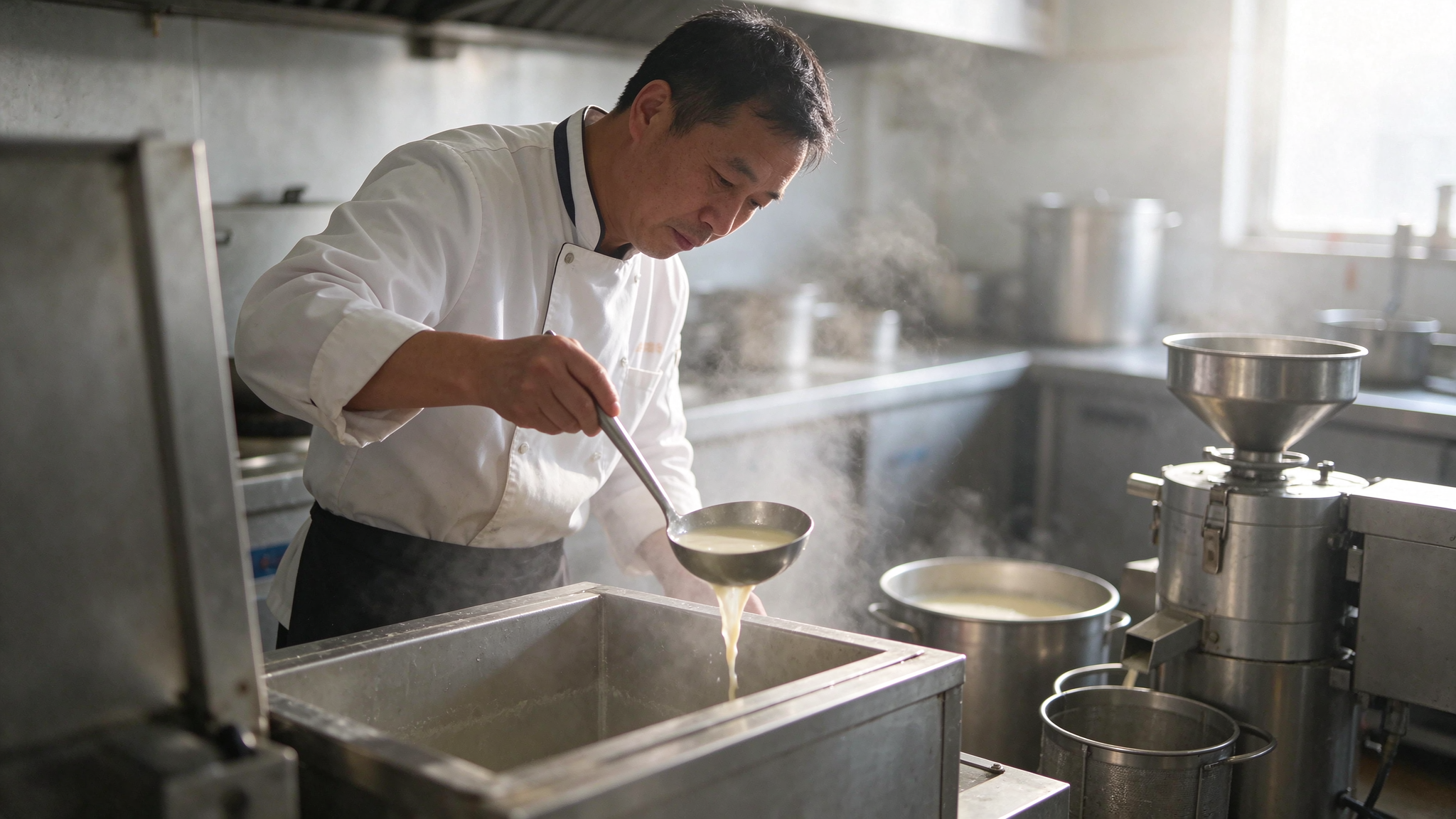
Thin milk reads before it is tasted: the stream runs off the ladle in a narrow line instead of holding together. Check the ratio and the soak before opening the grinding head.
1. Ratio, Soak and Second-Pass: The Three Causes Behind 80% of Thin Batches
Why is my commercial soy milk maker producing watery milk? Four times out of five, one of the three causes below is responsible — and all three are measuring habits, not machine faults. Check the water-to-bean ratio first: batches thin out the moment the ratio drifts past 1:10. The three highest-frequency causes:
• Cause 1 — Ratio drift: free-pouring water instead of weighing it. Fix: hold the water-to-soybean ratio at 1:8 for drinking milk (1 kg dry beans + 8 L water). If staff dilute after grinding to hit a volume target, that is Cause 7 — same fix, different culprit: plan volumes at the hopper, not the jug.
• Cause 2 — Under-soaked beans: beans need 8–12 hours in water (8 in summer, up to 12 in winter). Under-soaked beans are hard at the core, so the wheel crushes instead of grinds and milk stays locked in the pulp. Use this soybean soaking time chart for commercial soy milk machines: summer 20–25°C → 8 h; spring/autumn 15–20°C → 10 h; winter below 10°C → 12 h; refrigerated storage → add 2 h. Laminate the chart and tape it above the prep sink — soak discipline is the cheapest texture lever you own.
• Cause 3 — Skipped second pass: re-grinding the first okara through the machine with a little fresh water recovers 1–1.5 more liters per kilogram. Skipping it is the cheapest way to lose both yield and body in the same batch.
✅ Bottom line: Weigh water, soak by the temperature chart and re-grind the okara — those three habits end most watery-milk complaints without touching a wrench.
2. Grinding Wheel Gap Adjustment for Fine Soy Milk Texture (Plus Screen Checks)
The remaining causes live inside the machine, and the first check is the grinding wheel gap adjustment for fine soy milk texture — a gap set too wide, or a wheel worn smooth, lets whole slurry through unrefined. On a typical 95 mm wheel unit, run these four checks:
• Cause 4 — Gap too wide: wind the adjuster down until the wheel just feathers the beans with a light drag, then back off a quarter turn. Too tight overheats the motor; too wide feeds unground slurry straight to the spout.
• Cause 5 — Worn wheel: if the grooves feel smooth to a fingernail or output per hour has dropped by a third, the wheel is done. Wheels are wear parts — a fresh pair costs little and restores full yield in minutes.
• Cause 6 — Wrong or torn screen: a split 100-mesh screen passes pulp fragments that both thin the body and add grit. Hold it to the light; any pinholes mean replacement.
• Cause 7 (mechanical variant) — Slurry temperature: grinding cold, under-heated slurry reads thinner on the palate even at a correct ratio. Bring soak water and rinse water to ambient before the batch.
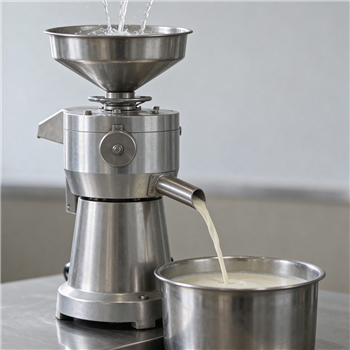
Every YASILE export unit ships with a spare grinding-wheel pair, two screens and a filter bag in the carton, so causes 4–6 are fixed same-day. If your machine is another brand and parts are hard to source, the fastest exit from the watery-milk loop is often a factory-direct replacement — see the self-separating pulping machine range or the 100 Standard with included spares.
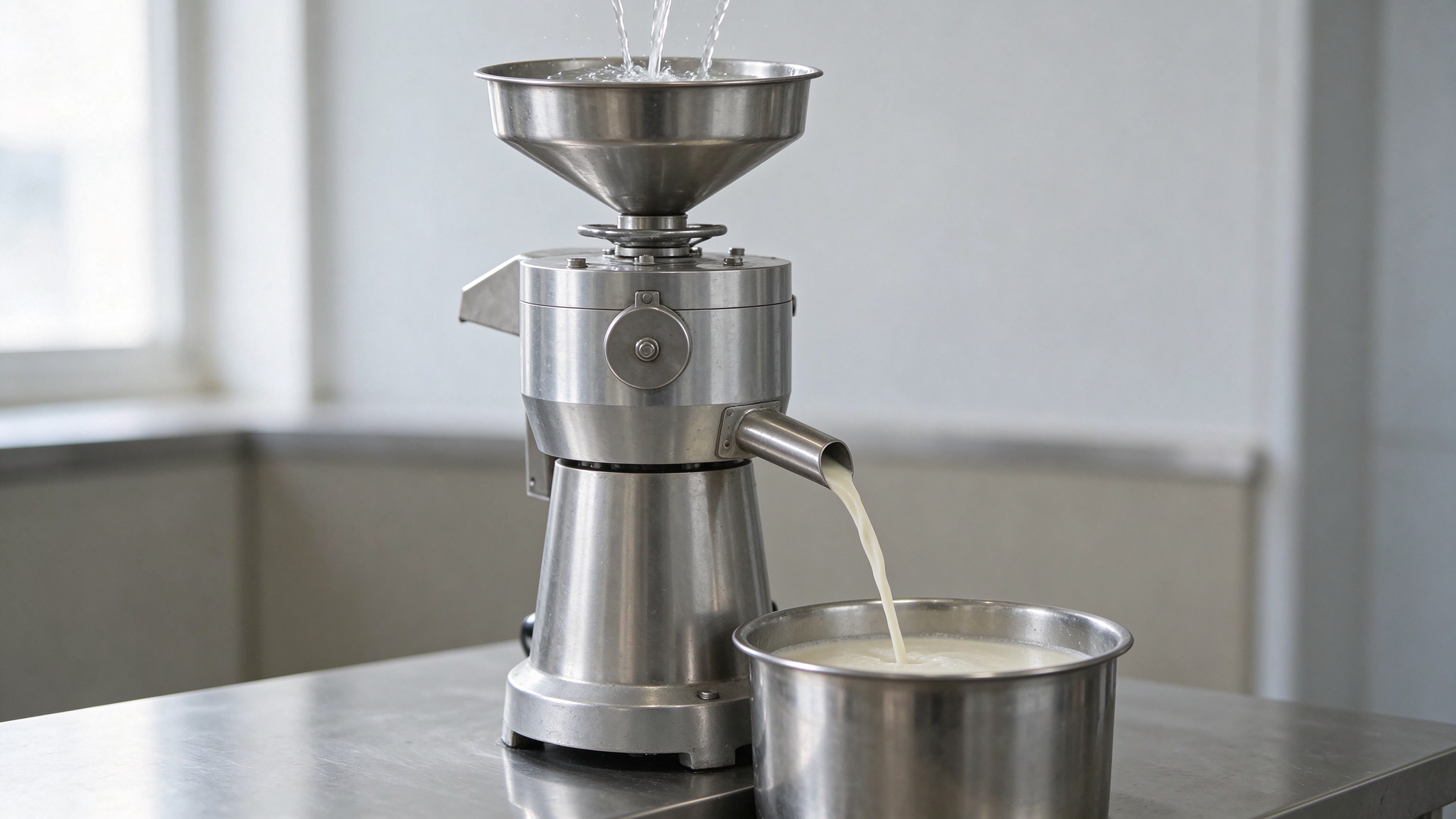
One spout, one receiving pot: the slurry is what the wheel gap and the screen decide, which is why the head is the first place to look when a batch runs thin.
✅ Bottom line: Feather the wheel gap, swap worn wheels and screens on schedule, and texture returns to spec the same batch.
Frequently Asked Questions
Q: How often should we replace the grinding wheels in daily commercial use?
A: Roughly every 6–12 months at one batch a day — sooner if output per hour drops. Keep a spare pair on site; YASILE includes one with every machine.
Q: Our milk is watery only in the first liter of each batch — why?
A: The first slurry rinses residual water from the previous clean-down through the system. Discard or re-grind the first 300–500 ml and the rest of the batch will hold body.
Q: Can a worn machine be repaired, or is replacement the better call?
A: If the body and motor are sound, new wheels and screens solve it. For machines without parts support, Zhenjiang Yasile Kitchen Appliance Co., Ltd. supplies factory-direct replacement units with voltage adapted to your market — send us your batch volume and we will quote same week.
Send Us Your Batch Details — Free Diagnosis
Describe your ratio, your soak routine against the soybean soaking time chart for commercial soy milk machines, and your machine model to YASILE, and our engineers will identify which of the seven causes is thinning your milk — usually within one business day, free of charge. If the machine itself is the bottleneck, we will quote factory-direct replacement wheels, screens or a complete unit sized to your volume. Contact YASILE — pulping equipment manufactured in Zhenjiang, China since 1999.
Related products
-
PGA Frac Ball
Contact UsPGA fully degradable frac plug ball is a series of frac plug balls developed based on PGA degradable materials to meet the needs of oil fields under various temperatures and working conditions.
-
-

1500A Jump Starter with Air Compressor
Contact UsExperience ultimate convenience and reliability with our 1500A Jump Starter featuring a 150 PSI Air Compressor, ensuring you’re always prepared for any roadside emergency.
-

7000A 12V&24V Jump Starter for Truck Starting in -40C
Contact Us(*For Jump Starter ODM/OEM Solutions, secure your exclusive quotation now!)
Reviews
There are no reviews yet.