
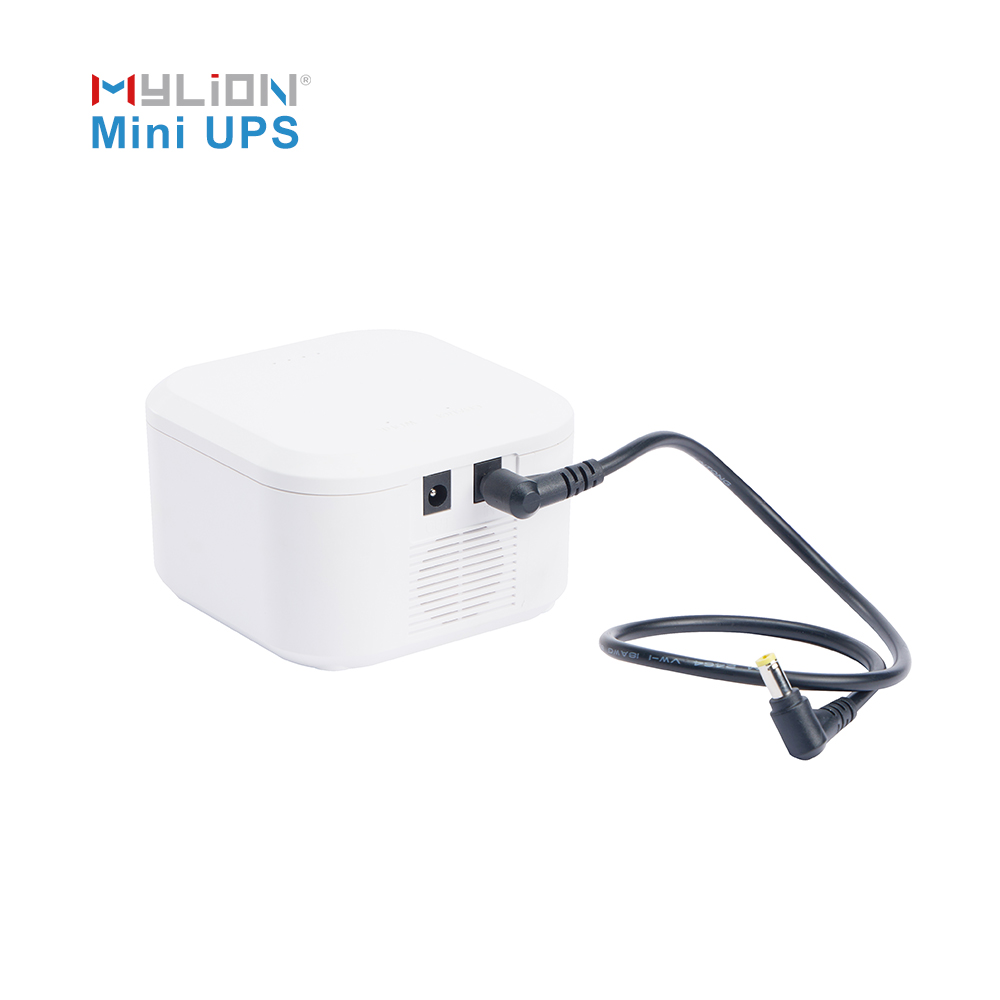
Mini UPS Procurement Checklist: What Buyers Must Verify
Mylion Mini UPS is the compact, reliable power backup solution designed to keep your critical devices running during unexpected outages. Engineered for home offices, network setups.
Why a Procurement Checklist Matters for Mini UPS Sourcing
Network equipment such as routers, modems, and ONTs are highly sensitive to even brief interruptions in power quality. Short outages, voltage drops, or unstable grid conditions frequently cause these devices to reboot or lose service entirely. For telecom operators, Internet Service Providers (ISPs), broadband network companies, fiber network operators, and system integrators, this is not a minor inconvenience—it directly affects service continuity for end subscribers. Improper UPS selection regarding voltage, current, peak load, or connectors can lead to outright application failure, making a disciplined procurement checklist essential rather than optional.
Shanghai Mylion New Energy Co., Ltd., operating under the brand name MYLION, has built its positioning around solving exactly this problem. As a global B2B provider of Mini UPS products, DC backup power solutions, and project support for telecom, ISP, broadband, and security applications, MYLION approaches procurement as a technical matching exercise rather than a simple product sale.
Core Electrical Parameters to Verify First
Before any Mini UPS is selected, buyers should confirm three foundational electrical characteristics of the target device: actual operating voltage, working current under normal load, and peak or startup current behavior. These figures must be evaluated against real device specifications rather than assumptions, since a mismatch in any of these areas is one of the most common causes of deployment failure.
MYLION’s differentiated approach centers on evaluating solutions based on real device voltage, working current, peak/startup behavior, and installation environment, followed by technical confirmation and connector/cable matching to reduce selection errors. This methodology supports more reliable DC backup deployment and reduces avoidable selection risks for professional project customers.
Matching Output Current to Load Type
Standard-load equipment typically requires 2.5A continuous output, while high-performance WiFi equipment and storage-integrated gateways often demand higher thresholds. Buyers should always confirm whether their target device falls into standard or high-power categories before finalizing a model.
Connector and Cable Compatibility
Even when voltage and current specifications are correct, a mismatched connector can render a UPS unusable. Interfaces such as DC5521 input and DC5525 output, including center-positive configurations, must be checked against the equipment’s existing power interface. MYLION’s service scope explicitly includes connector/cable matching as part of its requirement analysis and model matching process, helping ensure that physical compatibility is addressed alongside electrical compatibility.
Battery Chemistry and Capacity Considerations
Battery energy capacity should be chosen according to required runtime rather than a generic "bigger is better" assumption. Buyers should ask: how long does the device need to remain operational during an outage, and what battery energy (in Wh) supports that duration without oversizing the unit unnecessarily.
MYLION’s portfolio spans LiFePO4 chemistry integration across several product lines, reflecting a focus on stable, well-documented battery technology. The company brings 13+ years of experience in Lithium Battery technology and 10+ years of experience in Mini UPS development to this area of the checklist, supporting informed capacity decisions.
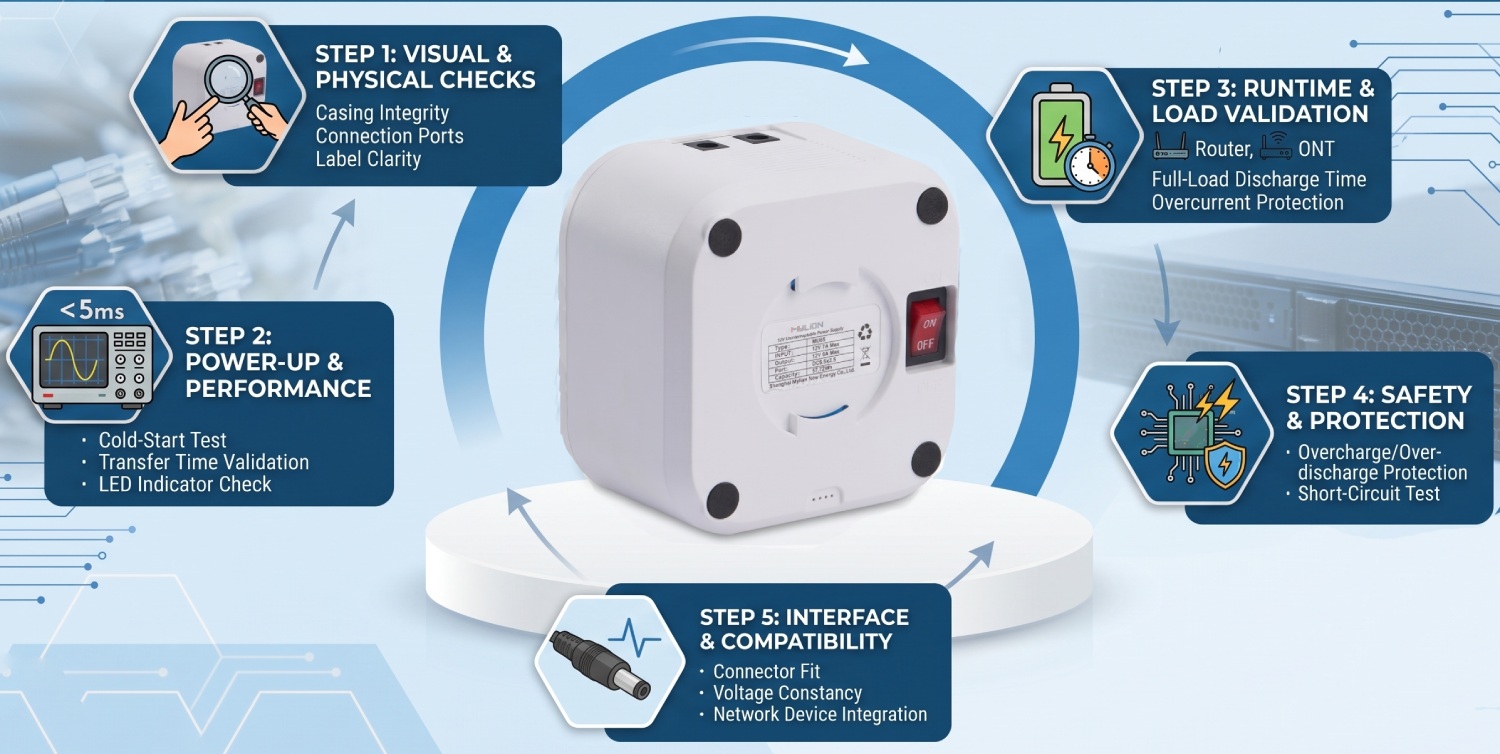
Reviewing the Relevant Product Line Before Ordering
A sound procurement checklist also includes confirming which product series aligns with the specific use case. MYLION organizes its Mini UPS offerings into distinct series to simplify this step:
- 12V Standard Series (including MU26W, MU48W, and MU68W): entry-level to mainstream broadband backup, supporting 2.5A continuous / 3A maximum output with battery energy ranging from 18.72Wh to 44.4Wh depending on model.
- 12V Long-Runtime Series (MU635W / MU635L): standard 2.5A/3A output paired with 75.6Wh battery energy for extended backup duration.
- 12V High-Power Series (MU65W): 4A continuous / 5A maximum output (60W total) with 56.16Wh battery energy for high-load CPE or gateways exceeding standard current thresholds.
- 12V High-Power Long-Runtime Series (MU35W / MU35L): combines 4A continuous / 5A maximum output with 75.6Wh battery capacity for professional gateways requiring both high peak current and long backup time.
- 12V + USB Multi-Output Series (MUJ46, MUJ435): simultaneous 12V DC and 5V USB-A/USB-C outputs within an 18W system limit, suited to small office/home office setups requiring multi-device backup.
- AC-Input Dual Output Series (ML1202AC): a LiFePO4 UPS accepting 100–240V AC input and delivering two independent 12V DC outputs (2A each, 24W total), designed for combined ONT and router installations without an external DC adapter.
- Development/Project-Evaluation Directions (MUC85, MU248): emerging USB-C PD 100W input/65W output capability and 24V/48V telecom backup directions, currently available for project evaluation.
Confirming Platform and Equipment Compatibility
Procurement teams should verify that the selected Mini UPS is compatible with the specific device category in use—routers, ONTs, ONUs, modems, gateways, CPE devices, or security/CCTV equipment—while subjecting this compatibility to electrical verification rather than assuming universal fit based on category alone.
Checking Documentation, Certification, and Service Support
A complete checklist extends beyond the product itself to the documentation and service model surrounding it. Buyers should confirm whether relevant certifications, such as model-specific UN38.3 and MSDS documentation, are available, since these relate directly to lithium battery transport documentation and compliance requirements.
Buyers should also evaluate the service model offered by the supplier. MYLION provides B2B project support, OEM/ODM services, and sample validation, covering requirement analysis, model matching, sample testing support, connector/cable matching, private labeling, and documentation coordination. This extends to managed pilot evaluation and mass-production preparation, which is particularly relevant for system integrators and brand owners planning larger deployments.
Pricing and Delivery Expectations
Finally, procurement teams should clarify pricing and delivery terms early in the process. MYLION applies a custom enterprise and project-based quoting approach rather than fixed retail pricing, reflecting the project-specific nature of B2B backup power deployment. Deployment itself is typically structured as device-side hardware installation for subscriber-side equipment, supported by after-sales technical evaluation, model matching, and project-specific documentation coordination.
Conclusion
A reliable Mini UPS procurement checklist must cover electrical parameters, connector compatibility, battery chemistry and capacity, platform compatibility, product line alignment, certification documentation, and service support structure. Shanghai Mylion New Energy Co., Ltd., through its MYLION brand, structures its global B2B offering around exactly these verification points—serving telecom operators, ISPs, broadband network companies, fiber network operators, and system integrators with a model-matching approach designed to reduce avoidable selection errors before deployment begins.
Related products
-
KM322 GPS/BDS/GLONASS/Galileo/QZSS All-constellation Multi-frequency High-precision RTK Positioning & Heading Module
Contact UsThe KM322 is a high-precision GNSS positioning and orientation module developed by Kepler.
-

Industrial 5G Routers: Solving Connectivity Failures in Extreme Environments
Contact UsFrom Shenzhen E-Lins Technology Co., Ltd., a provider with 20+ years of industrial communication expertise and deployment across 150+ countries.
-

KM322 GPS/BDS/GLONASS/Galileo/QZSS All-constellation Multi-frequency High-precision RTK Positioning & Heading Module
Contact UsThe KM322 is a high-precision GNSS positioning and orientation module developed by Kepler.
-
KB20 Kit: Single-base CORS system, Base Station
Contact UsThe KB20 BeiDou Single Base Station is an independently developed ground infrastructure for the BeiDou Navigation Satellite System by Kepler.
Reviews
There are no reviews yet.